Showing posts with label book reviews. Show all posts

Wednesday, September 17, 2025

Book Review: The Old Man and The Sea

Old Man and the Sea by Ernest Hemingway -1952 cover 


I can't tell you how many times I have handed this book (with the earlier cover) to library patrons over the years. Yet, I had never read it! Not sure why.

It is a simple story covering less than a week, and focusing on a three-day battle between an old fisherman and a fish (shark). It includes a story of the interactions between the fisherman and a young man who spends time with him.

I am still parsing the meaning of the metaphor/analogy presented. I will need to think some more. 

Saturday, July 05, 2025

Book Review: You Are My Sunshine: Jimmie Davis & the biography of a song

One of the speakers at the Louisiana Library Association (LLA) Conference this year was Robert (Bob) Mann. He is a a professor emeritus of mass communication at Louisiana State University. He held the Manship Endowed Chair in Journalism at the Manship School of Mass Communication at LSU for 18 years. He is the author of ten books, including critically acclaimed political histories of the U.S. civil rights movement, the Vietnam War, American wartime dissent, Ronald Reagan, and the 1964 presidential election. {source: https://www.robertmannbooks.com/about-robert-mann} He worked as a journalist and then for several prominent Louisiana political figures.

This book is a combination of history of the song and its popularity, biography of Jimmie Davis, and commentary both on aspects of Louisiana politics and the societal issues from the 1920s to the present. It is exceedingly well written.

So many of us have sung or heard this song sung with no understanding of the origin story. I did not know very much about the two-time governor Jimmie Davis before I read this book. As I noted above, one of the foci of the book is his complicated story.

As part of the analysis of the song, Bob Mann includes discussion of the various "covers" of the song over time. Someone who is more musically astute than I could make a great web site linking to all the different versions which have been recorded over time. I would enjoy listening to some of these while reading the stories of how they came about.

It is a well researched work with 17 pages of footnotes (technically end notes), seven pages of bibliography, and an index. Anyone doing work on Jimmie Davis or the role of this song in the American pantheon would find this a seminal work. I am very glad that I read it!

P.S. I commend reading this article about his departure from LSU. It has some interesting, pointed perspectives including on the brain drain from the state: https://slate.com/news-and-politics/2023/10/why-robert-mann-quit-lsu.html 

Tuesday, September 20, 2022

Grant a significant biography


Grant by Ron Chernow [book cover]
Earlier this year a friend posted on Facebook about the bicentennial of Ulysses S. Grant (April 22). I quickly realized how little I knew about the 18th President. I knew he had been a general, and was the commander of Union forces who accepted the surrender of Robert E. Lee at Appomattox. He also had a reputation for being (depending on to whom you listened) a heavy drinker or a drunk. I also believed that his administration was wracked with scandal.

The book by Ron Chernow is massive. The copy I borrowed was in large print - and the text ran to 1,289. Those pages are followed by another 190 pages of notes, bibliography, and photo/illustration credits. (It is a pretty fat book at 1,479 pages!)

Grant was much more than just a general and a drunk. While this biography talks about his drinking issues, Chernow notes that whatever drinking Grant did was away from any significant activities. He was not ever drunk during a battle or a crucial time in his administration. Some of that credit belongs to one of his personal assistants, and to his wife Julia. He did have a "drinking problem," but especially at the end of his life, he seemed to be able to control it. According to this biography, he never drank leading up to and during a battle. He would occasionally go on binges. There were two people who helped reign him in, one was his wife Julia, and the other a long-suffering and long-serving assistant John A. Rawlins. It's a fascinating relationship, and there is one (much shorter) version of the story on History.net.

I strongly recommend the book. The description of Grant's political acumen and actions as President were not something I had known about. The election of his successor ushered in the era of Jim Crow, which undermined much of what Grant tried to do as both a General and as the President.

The very end of his life was sad in that he rushed to finish his memoirs (published by Samuel Clemens/Mark Twain) in order to leave funds for his wife. The next time I drive east, I will try to visit both his tomb (in New York City) and where he spent much of his final time writing in Saratoga Springs (NY). I suppose, his version of his life should be added to my reading list!

Sunday, May 15, 2022

John Cheever: Complete Novels


More on Cheever! I have now finished reading John Cheever's Complete Novels, also in the Library of America edition (902 pages, plus notes and chronology). As I noted about his stories, I feel like this should count for more than one volume ... There are actually 5 novels in this compilation (in order of publication - and presentation):

  • The Wapshot Chronicle
  • The Wapshot Scandal
  • Bullet Park
  • Falconer
  • Oh What A Paradise It Seems

At times, the novels felt like short stories, and some of the characters from the novels either previously or subsequently appeared in the short stories.

I feel like the short story was Cheever's metier and real strength in writing. All of his works are "of a time and place." Because it represents both a geography and a time period with which I am familiar, it felt comfortable to me - and likely his writing was well received by "the establishment" since it was so much about them.

I am glad that I read all of his works, and have an appreciation for what he describes. 

Sunday, December 20, 2020

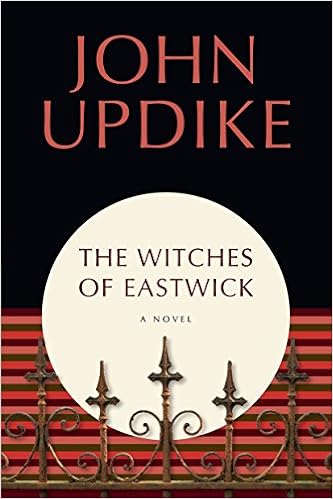
Updike's Witches


I recently did something that I think I have never done before ... I read a couple books and then immediately watched the movie made from one of them. I no longer remember what inspired me to pull from the library stacks The Witches of Eastwick by John Updike. But this late fall, I was off and running/reading.

I have read Updike before. I read several of his books prior to introducing him at the Connecticut Library Association Annual Conference in 2000. After the Conference, I also read the book he was promoting at that time (Gertrude and Claudius) as well as an older collection (Bech is Back - which he most thoughtfully inscribed to me).

This time I did the following in this order:

  1. Read The Witches of Eastwick
  2. Read The Widows of Eastwick
  3. Watched the movie: "The Witches of Eastwick"

The action in The Widows takes place 30 years after the activities of The Witches. The Widows is an interesting take on the aging process, in addition to the other themes which follow from one book to the other. The theme of aging and those changes is a one which Updike explores in other works (most notably to me, the Rabbit series).

I was disappointed and disturbed by the movie adaptation. In both of the books, the women characters (Sukie, Jane, and Alexandra) are portrayed as strong women with a bond with each other, and having developed/found their unique skills which are most powerful when they are together. Darryl as a character arrives in Eastwick after there has already been action from the women. In the movie, however, Darryl (played by Jack Nicholson) is portrayed as the force which develops and binds the women's powers.

In the Wikipedia entry on The Witches (the book) it notes:

Updike described his novel as "about female power, a power that patriarchal societies have denied." Many scholars viewed it as strongly pro-feminist, "an intelligent engagement with feminism, and a rare case of a male novelist writing from women's points of view." Some have expressed concern that the book may be misogynistic, as it seems to reinforce the patriarchal conceptions of women as witches and of women requiring a man for personal growth; others believe that the book may be more of a satire of such ideas.

The movie clearly takes a different tack, as a vehicle for Nicholson, and focuses on his presence as the driving force - and the ending of the movie is a dramatic difference from the book - having repurposed one of the plot lines.

It has been interesting.

I will also confess, that part of the attraction for me was the setting. Eastwick is a fictional town on Narragansett Bay in Rhode Island. It is a setting with which I am familiar. I could see the setting in my minds' eye ... could hear the voices (and accents) ... could almost smell the salt air, and the mustiness endemic to older, wooden-framed homes near the salt-water coast.

I recommend the books - both of them. The movie, not so much.

Saturday, September 21, 2019

Seeing My Skin - a review

Jarrett-Schell, Peter, Seeing My Skin: (A Story of Wrestling with Whiteness) [New York]: Church Publishing, [August 17] 2019.

I picked this up as an ARC (Advance Reader’s Copy) at ALA this summer. In unusual fashion, I actually was reading it as the publication date arrived. It has made me stop and think about many of the things I think, say, and do.

The book opens with an incredibly powerful vignette of an actual event, and is the author's Facebook posting of that event. The rest of the book is divided by location and starts with a series of vignettes, followed by a “debriefing.”

The stories tell of his experiences of the racial divide and his reactions to what he has experienced. It starts with his growing up, and ends with incidents after the most recent presidential election. The debriefing section of each chapter is probably the most powerful.

The author is an Episcopal priest who met his wife in college. She is also an ordained Episcopal priest. He is white, she is black.

I think this a book which I want to sit and read again … that doesn’t often happen.

Thursday, May 10, 2018

Hard to Forget - Book Review

I recently finished reading Hard to Forget: an Alzheimer's Story by Charlie Pierce.

I don't usually read medical non-fiction. But having recently reconnected with a grammar school friend, we were talking about our high school buddies. Charlie and I grew up in the same town, close to each other, and for some of the early years of high school, we often walked to school together. I have been reading Charlie's stuff [off and on] for over 50 years. He wrote {for publication} in high school, and I would sometimes see his work in other places in more recent years. And, oh yes, this is *the* Charlie Pierce of "Wait, Wait, Don't Tell Me."

I have some vivid memories of Charlie's mother, but for me, his dad was a shadowy figure at best.

Part of what I enjoyed was recalling some of the scenery and geography of town.

This is a heart-wrenching, vividly told, brutally honest story. Charlie mixes his information gathering about this debilitating disease with how he and his family reacted to the progression of the illness. Everything from denial, to doing everything possible to help his dad.

It received excellent reviews when it was first published.

I am glad that I read it. In my professional life, "my" division of ALA includes a group of folks who provide services to those suffering from dementia and  their caregivers. As we baby boomers age, this will become an increasingly important service for public libraries to offer.

Thursday, December 24, 2015

Clementine Churchill: an undersung hero

I just finished reading Clementine: The Life of Mrs. Winston Churchill by Sonia Purnell.

Clementine Churchill lived an amazing life. She was incredibly under appreciated, both in her time, and now. I feel like I know a fair amount about Eleanor Roosevelt who was an incredible advocate. Clementine Churchill may well have done more for Britain (and the free world) than Eleanor, but has received almost no credit.

Born into impoverished nobility, she was about a decade younger than Winston Churchill. This book draws heavily from the copious correspondence between Winston and Clementine. They were generally not model parents, and the book does not sugar coat their shortcomings in this area. Clementine was privy to most of what Winston dealt with (including state secrets). She advised and challenged Winston, and was often the only one who could challenge him. She tempered him in many ways, and often re-wrote speeches and memos.

For a book where you know how it will end (there are no secrets about history), it was a gripping read. I even pushed it ahead of other books on my "to read" pile.

Saturday, February 28, 2015

Book Review: The Girl on the Train

Front CoverAre you a closet voyeur like me? When I am driving at night, particularly on back roads rather than on the Interstate, I will pass a house with one light on in the window, and wonder what the story is for why that one single light is on.


Well, that is part of the premise of this new and popular (among my friends, anyway) novel.

Part of the plot centers on one of the main narrators talking about her thoughts as she watches a particular house on her daily train commute.

The story is much more complicated than that simple premise, since the first narrator used to live a couple doors down from the flat she is imagining the story of.

Hawkins uses shifting narrators (clearly labeled) and shifting time sequences (also clearly labeled) to tell an interesting tale.

Friday, November 07, 2014

Bourbon Street: A History – A book review

Bourbon Street: A History, Richard Campanella, Louisiana State University Press, 2014

I don’t usually do book reviews, but I felt compelled to talk about this one.

I love New Orleans. I lived there for four years, and that has certainly helped both develop my affection for the city and its people, but has also informed my ideas and opinions about the city. Prior to living there, I had visited the city about 8 – 10 times, always for a conference/convention. The areas I visited then were the French Quarter (including Bourbon Street), the CBD/Warehouse District and the Convention Center. Living there, and visiting since, I have seen much of the rest of the city which is different than the Quarter and has its own charms.

In the Preface, Richard Campanella notes: “And yet Bourbon Street has been almost completely ignored by scholars. Not a single book has been written about its history, much less an in-depth scholarly investigation.” This book fills that gap. The book is divided into three parts: Origins, Fame and Infamy, and Bourbon Street as a Social Artifact.

“Origins” sets the stage both in talking about the larger history, and some of the geography of the area. “Fame and Infamy” has a period-by-period history divided into six eras. The last part includes more interesting analyses. The book includes reproductions of maps and photographs, some from very early periods.

Part of the analysis of history and data that he does goes well beyond what I consider “geography” – a concept probably limited by my elementary school classes on the topic. Some of the modern data is based on research and data collected by the author: musical genre performed, volume of pedestrian traffic, numbers of men and women standing on balconies, origins of Bourbon Street pedestrians, and local versus out-of-state ownership of property

It is a fascinating history and discourse about the most famous part of New Orleans. It is a weaving together of tales told by history, and by data, along with anecdotes from the participants.

I had a chance to hear the author speak at the Louisiana Book Festival last weekend, and he was as engaging as his book.

Wednesday, June 26, 2013

On the Noodle Road -- a review

I am on a mailing list for advanced reader's copies of new books. Most of what I receive is fiction, but every once in a while another title slips in. This one really caught my interest:

    On the Noodle Road: From Beijing to Rome, with Love and Pasta by Jen Lin-Liu
    (publication date is 7/23....publisher page is here)

The author is a Chinese-American, raised in California and who now owns a cooking school in Beijing. While at a dinner in Italy, she began to wonder about the "age-old question" on the origin of noodles. Did Marco Polo really introduce the noodle from China to Italy?

This work is a little cultural anthropology, a little cooking skills, a little travel guide, a little meditation on the role of women and feminism. It is a delightful, eclectic mix of all of the above. At the time of her trip, she had recently married, and that is part of the rumination on the role of women in society and feminism.

Her trip was by surface transportation (for the most part - there was one hiatus where she flew back to Beijing, and then flew back to where she left off). Some of the trip is by train and car, but she also did some hiking, and some of the penultimate legs were by boat (ferry). Her trip took her across China, through several of the "-stans" into Iran and Turkey, and then to Greece and Italy.

I thoroughly enjoyed all aspects of this book. Especially at home, food is the province of women. In some of the countries she visited the role of women is strictly circumscribed. There are many societal implications. Several of the people she cooked with and learned from are women who do it because it is expected, not because they enjoy it. (I find that sad, but then again, I like to cook.) I gained insight that I did not expect about several of the areas she visited.

I did not cook any of the recipes, and even though I usually give away ARCs when I get them, I will keep this one for a bit to try some of the recipes.

Tuesday, January 01, 2013

Reading and a Book Review: Hidden America

I don't often do book reviews. I have started receiving ARC's (Advance Readers Copies) in greater volume lately, and I don't know why. Because of what else is going on in my life, my reading time has been reduced. I have also been shifting between my e-reader and print.

However, I recently finished Hidden America: From Coal Miners to Cowboys... by Jeanne Marie Laskas. One of the blurbs on the back compares Ms. Laskas to Studs Terkel, in a positive way. That is high praise, indeed.

It is a well written book and each chapter tells a discrete story. The first chapter, on coal miners, appeared as a separate article, and the others are similarly able to stand independently. Each are the personal story of Ms. Laskas as she explores some of the jobs or people who are critical to the running of the country on a day to day basis. By exploring the personal stories, we get a glimpse behind the scenes. They are fascinating glimpses which put a personal face on what happens to make our lives so comfortable.

The first chapter explores coal mining in Ohio. (Yes, there are underground coal mines under parts of Ohio.) The subsequent chapters cover migrant workers (mostly in Maine for the blueberry harvest), the cheerleaders for the Cleveland Browns, air traffic controllers at LaGuardia, a gun store in Yuma (Arizona), a cattle ranch in Texas, an oil rig in the Arctic, a truck driver (from Ohio to Iowa and back), and the "sanitary landfill" outside Los Angeles.

It is an amazing journey to follow, and I even learned a little about the author along the way. For those who can extrapolate from the personal stories to the general, this can be a very instructive book. I actually read the chapter on the air traffic controllers while on a trip. There are some scary things going on behind the scenes. I read the story on the gun store after the incident in Newtown which added a poignancy to some of what was expressed in that story.

Saturday, September 03, 2011

On Gorman

First about my relationship with Michael Gorman. I first met him when I started Library School at the University of Illinois at Urbana-Champaign (UIUC) in June 1975. He was teaching the introductory class for the library school at the end of his first stint in the US. Later, our paths crossed occasionally at ALA, including on ALA Council. At the Midwinter Meeting in 2003, I was nominated for election to the ALA Executive Board. Michael Gorman was nominated from the floor. When we gave our speeches to Council (the extent of our "campaigns"), I was assigned to sit at the end of the table on the podium, with Michael Gorman next to me. Thank goodness I got to speak first!

Along with Jim Rettig, we were both elected to the ALA Executive Board. The three of us began our service at the end of the ALA Annual Conference in Toronto. It was a lot of hard work, and a lot of fun. It was during our three year terms that Michael ran for, and won election to serve as the ALA President in 2005/06. So, at the ALA Annual Conference in New Orleans (2006), he ended his term as ALA President as Jim Rettig and I ended our terms on the ALA Executive Board. (And for those who don't know Jim, he ran for, and won election, as ALA President in 2007, serving as President in 2007/8.)

So, why am I blathering on about Gorman? I just finished reading Broken Pieces: A Library Life, 1941-1978. It is his autobiography. I found it fascinating, partly because I know him. It is also very personal and revealing about some of the mental health issues which he faced as he began his library career.

Cataloguers (especially those of a "certain age") will find the discussion on the production of AACR2 (Ango-American Cataloging Rules, 2nd edition) most enlightening.

As is his style, he is very forthright about his opinions. In this book, most of those opinions related to cataloging issues, from his evaluation of the older rules (pre-AACR) used in both the US and UK, as well as the proposal for a whole new scheme for cataloging methods.

He notes that AACR2 probably should not have been called the second edition, but been given a whole new name. Based on what I read in his work, I think I agree. I also agree with his comments about "tagging" versus the controlled vocabulary offered by Library of Congress Subject Headings (even with the shortcomings of LCSH).

It will be interesting to see what happens in the cataloging world. I feel better prepared to think about it and talk about it.

I think the book is well worth the time to read, even if you do not personally know Michael Gorman.

Monday, September 06, 2010

Book Review: Save the Last Bullet for Yourself: A Soldier of Fortune in the Balkans and Somalia

I don't generally do book reviews. I am making an exception. In this case, I actually know the author of Save the Last Bullet for Yourself: A Soldier of Fortune in the Balkans and Somalia by Rob Krott. Rob and I have met a couple times while on vacation.

The book is a memoir, and therefore told in the first person. I can so very much hear Rob telling this story. [That is a good thing, authenticity is important.]

Now, I am not a big gun person. Rob is. There is a lot of detail about munitions which went totally over my head. On the other hand, Rob also spends time talking about group dynamics and personal interactions. He has dealt with a variety of very "interesting" people in his travels. His education with the Franciscans at "St. Bony" and at Harvard Grad School do show through. I also don't want to discount the training from the US military over the years.

I wish that the book had maps for both Bosnia and Somalia. I am, in some ways, a typical American with only limited detailed geographical knowledge of Bosnia/Croatia and Somalia. I will say, that remembering those conflicts, I did gain more insight to what was going on in each of the situations.

I could see a talented scriptwriter making an interesting movie or semi-documentary from this memoir. I hope that Rob and/or his agent can find one.

Wednesday, June 02, 2010

Hungry Town

Huh? I can hear you say?

I just finished reading Tom Fitzmorris's Hungry Town: A Culinary History of New Orleans: The City Where Food Is Almost Everything. Now, I don't usually do book reviews here, but this one inspired me.

I met Tom at the Maple Street Bookshop when they held a book signing a few weeks ago. I will admit that it was the offer of free Sazaracs, that pulled me in.

Tom Fitzmorris has been a New Orleans food critic for a number of years, and for a variety of publications. He also has a very successful radio show. He gained national prominence with his web site which tracks the number of restaurants in the New Orleans area. Post-Katrina, it began serving as an index of the recovery of the city.

One of the statements that lives with me (and I had subconsciously found to be true), is that in New Orleans, the most common topic of conversation is food. In other cities it could be politics, or the weather, but here it is food and restaurants.

On August 26, 2005 there were 809 restaurants in the index. This includes small neighborhood "joints," but not fast food or take-out only locations. By April 17, 2007, there were exactly the same number of restaurants, and today it is almost 1,100. Not a bad place to live.

The books includes a great deal of history about various establishments, both current and closed. It also includes a few recipes, and tales about some of the famous chefs from New Orleans.

I highly recommend this book.

Saturday, May 31, 2008

Book Review and a reminiscence

At the PLA National Conference, I picked up an advance reading copy of a new book from Milkweed Press. It is Shopping for Porcupine: A Life in Arctic Alaska by Seth Kanter. It is Seth's second book, the first was a novel. He is a photographer and writer whose work has appeared in many publications.

It is partly a memoir, and partly a reflection on how life on America's last frontier is changing. His parents moved to rural Alaska and lived in an earthen igloo when he was born. There are great stories about his growing up years and his adventures. There are some very touching stories of the native people, and the values and skills he learned from them. There are great photos in the book, many of which he took. [In the ARC, the photos are in black and white, I can only imagine how great they will look in color. The publicist for the book has told me that they are in color in the final copy.

Reading the book brought back a poignant memory for me. When I was about 12 or 13, I met a young man who was growing up in Alaska. His grandparents lived down the street from my family (in Central Massachusetts), and their son came back with his wife and kid for an extended visit. Remember that in the 1960s, it was a very big deal and long trip to go from central Alaska to Central Massachusetts. I don't remember his name. What I do remember is part of what Seth reflects on his his book. This kids was socially pretty awkward. (Yes, even compared to me.) He was easily overwhelmed if there were more than a couple other kids around. (I have seven younger brothers and sisters and grew up in a suburban neighborhood during the Baby Boom. There were *always* lots of kids around.) It has also made me reflect on the differences between how I grew up and how my kids grew up. Besides a difference in environment, the sheer difference in demographics is incredible. On the street I lived on with my kids, they were among the few young ones for most of the time. There were one or two other children, but the neighborhood had not changed yet from the older owners to the younger ones who are there today.

Anyway, I recommend the book. It is a fascinating read and offers insight into a far corner of our country.

Sunday, March 23, 2008

Reading and giving up

I don't often start a book and not finish. The only one I can think of immediately is Grapes of Wrath which I have started three times, and have not made it past the first hundred pages.

I thought that I should read Jack Kerouac's On the Road, so when I saw the Library of America edition sitting in the new book area of the Library, I picked it up. I started reading it. It was quite a drag. It is billed as a novel, but with the first person narrative, and what appears to be a real story, I just don't get it. Late last year I read the memoirs of Jack's wife Edie Kerouac-Parker. It was not a bad read (even if not terribly well written). I had a very hard time with Jack's book.

Wednesday, November 28, 2007

Book Review: A Good Match

One of the books on my sidebar for the past few months is A Good Match: Library Career Opportunities for Graduates of Liberal Arts Colleges. It was published by ALA as part of its "ALA Research Series" and was written by my first boss as a professional Rebecca Watson-Boone.

It is a serious research work.

Rebecca surveyed librarians whose undergraduate degrees were from eight smaller (my judgment) liberal arts colleges -- mostly in the Midwest. They are:
  1. Carleton
  2. Denison
  3. Earlham
  4. Grinnell
  5. Kalamazoo
  6. Lawrence
  7. Macalester
  8. Swathmore
There were 864 people who answered the survey which was 11 pages (in the book) and had a total of 82 questions, some of which were open-ended and others had multiple sub-questions. It includes a rather complete survey of the literature on career choices and paths.

She also compares between institutions and across the generations. There were some generational differences, as well as differences between the graduates of specific institutions.

It is *not* light reading. However, I think that the experiences of the alums of these selected colleges can be generalized to the profession. [I certainly can identify with many of the answers presented.]

It is an interesting work, well worth the investment of the time to read it.

In the interest of full disclosure, I worked for Rebecca at the University of Arizona in the mid-1970s. It was a temporary position as the Business Reference Librarian in the brand new Central Reference Department of the University of Arizona Main Library. Rebecca and I have stayed in touch over the years, primarily through ALA. She is now an independent scholar living in New Mexico (of which I am personally jealous).