Since I have gone back into the pattern of posting this kind of info, here is my tentative, proposed schedule for ALA Annual. Note that it will change dramatically as I import events over the next day or so.
Showing posts with label Conference programs. Show all posts
Showing posts with label Conference programs. Show all posts
Monday, June 22, 2015


Tuesday, February 03, 2015
ALA Midwinter 2015 - Monday/Tuesday Notes
Monday Notes
Mondays at Midwinter always begin early. The 15th Annual MLK Celebration took place at 6:30 am. There was a larger turnout than in prior years – even with the bad weather. After a hymn, there was a selection of readings from the works of Marin Luther King, Jr. by representatives of the organizing groups. This was followed by the keynote speech by Cornel West and a call to action by my friend Satia Orange. The singing of “We Shall Overcome” was very poignant.A friend invited me to sit in for the LITA breakfast, which precedes the “LITA Town Hall Forum” which is part of LITA’s planning process. I had the opportunity catch up with some friends with whom I had not yet connected.
PLA is in the process of developing some tools to use as measures of outcomes of library services. It is being developed by the Performance Measurement Task Force. Their meeting was scheduled for 6 hours (!). I attended the beginning.
I attended the beginning of the second session of the ASCLA Board of Directors and had the opportunity to hear ALA Presidential candidate Julie Todaro. I left to attend the ALA Executive Board Candidates Forum because several of those candidates had asked me for advice. However, the session was moved up in time because the business at ALA Council II did not last as long as budgeted. I did attend the APA [American Psychological Association] Lunch & Learn @ ALA Midwinter 2015 where some new features of their products were presented. It is interesting that vendors/exhibitors are the ones who provide most of the “content” or learning opportunities at Midwinter. Midwinter is technically a “meeting” not a conference, but a time and place for the Association’s committees to meet and do business. In the evening, I attended a social/networking event which I have been attending for over a decade.
Tuesday Notes
I packed and headed to the Convention Center. I wanted to get there early to be sure that I was there for the Memorials and Tributes. (I helped write, and seconded one of the Memorials.) I also wanted to get set up to be part of the LSSC course webinar this morning. I am pleased to report that the webinar went well – without a hitch. I purposely did not have a microphone, but I did try out my laptop web cam, and at the end of the session was able to show the room.Monday, February 02, 2015
ALA Midwinter 2015 - Sunday Notes
My morning began with breakfast with a state librarian from another state (whom I consider a friend as well as colleague) and a vendor which let us talk about our vision of the future for delivering e-books to state populations.
On Sunday, I had the opportunity, at two
different times, to visit the exhibits. It is always interesting and a way to
find out about new technology and trends. E-book platforms (delivering
materials from various vendors/sources) seems to be a growing field. Maybe this
falls under the topic of “user experience.”
My lunch was at the OCLC Update which is
always a well-attended event. I had the opportunity to spend a little bit of
social time with someone with whom I had spent some time in service on ALA
Council.
The Washington Office program “Tell the
IRS” was disappointing and encouraging at the same time. The IRS representative
did not make it to the conference due to the weather. However, it was Emily
Sheketoff, Director of ALA’s Washington Office who ran the program and
committed to getting libraries/librarians at the table in discussions with the
IRS.
 |
| 2015 Chicago Blizzard from the Conrad Hilton Suite |
I was pleased to see the attendance at
the BARC/Division Leadership Meeting. There were many more people who attending
this year that I remember from when I was on the Planning and Budget Assembly
or on the ALA EB Finance and Audit Committee.
The PLDS Statistical Report Advisory
Committee Meeting was very focused on that particular survey.
My official day ended with a gathering
to remember Don Sager. Don was long active in ALA and was someone who had
quietly helped me in my days on Council. Don also was the husband of former ALA
President Sarah Ann Long.
I watched the Super Bowl with mostly
Seahawks fans in the Conrad Hilton Suite. The suite sits very high, at the top
of the Hilton on Michigan Ave. The snow was swirling and I could hear the wind
constantly whistling (in the fireplace of the suite).
ALA Midwinter 2015 - Saturday Notes
First thing on Saturday, I attended the
ASCLA Board Meeting. Since I am standing for election as President, I figured
that it would be good to show up, and see who is currently on the Board, and
meet those whom I do not already know. As a bonus, I got to hear two of the ALA
Presidential candidates. After the business part of the meeting, the Board
began a discussion related to the developing new ALA Strategic Plan. I had to
leave to go to other events.
I briefly attended the beginning of the Digital
Inclusion Survey: Update. Since I serve on the Advisory Committee, I did not
stay because I
- Had heard some of the info before and
- Knew I would hear more at the committee meeting.
I briefly attended the discussion which
was preparation for the RUSA President’s program at Annual. That will be a
presentation by dana boyd and discussion of her new book It's Complicated: The Social Lives of Networked Teens (available
for free download at http://www.danah.org/itscomplicated).
I have now downloaded it to my phone (my first iBook), and have started reading
it.
Lunch turned out to be an interesting
vendor presentation. It was billed as “The Big ‘B’ - What branding can do for
your library” presented by Springer. There was some “content” followed by
presentations on how they are working with libraries in trying to apply some of
the concepts. Their campaign is called “Where do you library?”
The Digital Inclusion Survey Committee
Meeting may have been the last, and certainly was one of the last. We reviewed
a number of issues about the data collection and about the reports.
The ALA Presidential Candidates Forum
was an opportunity to hear all four of the candidates. I even had the opportunity
to ask a question!
Various receptions offered an
opportunity to meet with friends and make new ones. My evening ended at ALA-APA
Networking Reception. The Library Support Staff Certification Program is near
and dear to my heart. This was a chance to chat with some others who share this
passion and the staff who are the ones who actually make it all work.
ALA - Midwinter 2015 - Friday Notes
I attended the meeting of Managing With Data: PLAmetrics. That meeting focused more on the practical issues of running the survey.
Later I was at the beginning of the RMG Annual Presidents’ Seminar. This program has been going on for 25 years, and traditionally occurs on the Friday afternoon of Midwinter. This year, I was only able to stay for the beginning of the introductions (in part because the Scheduler listed it as starting at 1:30, and RMG listing it as starting at 2 pm). I left to go to the informal (i.e., not in the ALA Scheduler) ASCLA E-Books Interest Group which was held in the Executive Director’s Suite. There is a separate blog post about that.)
The evening ended with the Retired Members Round Table Dinner which was a wonderful event where I was able to meet up with a number of colleagues, some of them recently retired. This one was organized by Michael Gorman (former ALA President).
Later I was at the beginning of the RMG Annual Presidents’ Seminar. This program has been going on for 25 years, and traditionally occurs on the Friday afternoon of Midwinter. This year, I was only able to stay for the beginning of the introductions (in part because the Scheduler listed it as starting at 1:30, and RMG listing it as starting at 2 pm). I left to go to the informal (i.e., not in the ALA Scheduler) ASCLA E-Books Interest Group which was held in the Executive Director’s Suite. There is a separate blog post about that.)
The evening ended with the Retired Members Round Table Dinner which was a wonderful event where I was able to meet up with a number of colleagues, some of them recently retired. This one was organized by Michael Gorman (former ALA President).
Wednesday, January 28, 2015
ALA Midwinter Schedule - 2015
This is tentative, and, as always subject to change. Unlike my friend Aaron Dobbs, I did not break the scheduler this year.
Friday, January 29, 2010
January links - part 2
LibLime purchase what does it mean? Go to Hellman has an interesting take.
EBSCO exclusive contract comments the great Open Access advocate Dorothea Salvo has a great set of thoughts about the implications of the EBSCO contract
Getting older? An interesting post
A great post on Twitter and ALA is Everything I Needed to Know about Twitter I Learned at Midwinter on the YALSA blog
Heidi Blanton has an interesting post on managing conference information.
The Learning Commons is one of the hot topics in academia. I have a close personal friend who "coordinates" the Learning Commons for a Louisiana private university, so I hear a lot about it. Kim Leeder has an early January post on In the Library with the Lead Pipe (a great blog title, I think) with a very broad vision of what LC is all about. Read it here.
The New York Times is back-sliding! In the beginning of the web, their web site was free. Then they went to a pay site. Folks stopped reading it, and did not pay, so they went free. Now, they are going back to pay or at least "partial pay." Ars Technica has a good overview.
Facebook's privacy changes caught attention. Here is some of what I picked up:
Violating contract with users
Facebook developer says privacy is over
And then a comment about why the new policy is wrong
What the Internet and filters can do. A respected Canadian magazine has to change its name. Here is the story.
Will Manley is blogging at a new location. Here is his new blog. Even though we worked in Arizona at the same time, I never met him until he spoke at the Connecticut Library Association back in the late 80s or early 90s.
One of my nieces is working at the Olympics as part of an internship. She is blogging, and it should be interesting to read her experiences.
Agnostic, Maybe [Andy, in New Jersey]has a couple of interesting posts, the first is on the future of libraries, and the second is a reaction to another author's post called "Nothing is the future."
EBSCO exclusive contract comments the great Open Access advocate Dorothea Salvo has a great set of thoughts about the implications of the EBSCO contract
Getting older? An interesting post
A great post on Twitter and ALA is Everything I Needed to Know about Twitter I Learned at Midwinter on the YALSA blog
Heidi Blanton has an interesting post on managing conference information.
The Learning Commons is one of the hot topics in academia. I have a close personal friend who "coordinates" the Learning Commons for a Louisiana private university, so I hear a lot about it. Kim Leeder has an early January post on In the Library with the Lead Pipe (a great blog title, I think) with a very broad vision of what LC is all about. Read it here.
The New York Times is back-sliding! In the beginning of the web, their web site was free. Then they went to a pay site. Folks stopped reading it, and did not pay, so they went free. Now, they are going back to pay or at least "partial pay." Ars Technica has a good overview.
Facebook's privacy changes caught attention. Here is some of what I picked up:
Violating contract with users
Facebook developer says privacy is over
And then a comment about why the new policy is wrong
What the Internet and filters can do. A respected Canadian magazine has to change its name. Here is the story.
Will Manley is blogging at a new location. Here is his new blog. Even though we worked in Arizona at the same time, I never met him until he spoke at the Connecticut Library Association back in the late 80s or early 90s.
One of my nieces is working at the Olympics as part of an internship. She is blogging, and it should be interesting to read her experiences.
Agnostic, Maybe [Andy, in New Jersey]has a couple of interesting posts, the first is on the future of libraries, and the second is a reaction to another author's post called "Nothing is the future."
Monday, June 08, 2009
ALA Calendar
Here is my attempt at inserting my ALA calendar using Google Calendar.
The only info in here is my ALA Schedule from July 10 - 15. It is (of course) still subject to revision.
Update 6/9: revised to actually work....I hope.
The only info in here is my ALA Schedule from July 10 - 15. It is (of course) still subject to revision.
Update 6/9: revised to actually work....I hope.
Tuesday, June 17, 2008
Marketing that Matters (review)/Diversity @ Your Library (program)
I serve on ALA's PR Assembly. This group of people is responsible for planning the Public Relations Forum at ALA's Annual Conference. The official charge is:
This year the speaker is Eric Frienwald-Fishman. Eric is the author of a book Marketing that Matters: 10 Practices to Profit Your Business and Change the World. The book talks about Eric's business the Metropolitan Group as well as that of his co-author Chip Conely who founded the Joie de Vivre hotel group.
They talk about a large number of other business who use socially responsible business practices to not only make a living, but to provide significant employment and to change the world. They, successfully I believe, present ways that businesses can act in socially responsible ways and still be successful on any business scale. Among other things they note that the SRI segment of the investment market is currently 9.4% of the total market and growing. The show a large number of businesses who practice ethical business, are business successes, and advance a positive social agenda.
Now here is the great news for those of you attending ALA in Anaheim. You can hear Eric in person on June 29, 2008 8:00-10:00 a.m. when he presents Diversity @ your library: Broadening Your Audience and Engaging Communities in the Anaheim Hilton, Pacific Ballroom B. Please join us!!
To provide a forum for the exchange of information about library public relations and marketing activities throughout the association and with other library groups and associations sharing an interest in library promotion. To promote cooperation and enhance the effectiveness of public relations activities throughout the association and to strengthen ALA's national public awareness efforts.[from the ALA Handbook of Organization.]
This year the speaker is Eric Frienwald-Fishman. Eric is the author of a book Marketing that Matters: 10 Practices to Profit Your Business and Change the World. The book talks about Eric's business the Metropolitan Group as well as that of his co-author Chip Conely who founded the Joie de Vivre hotel group.
They talk about a large number of other business who use socially responsible business practices to not only make a living, but to provide significant employment and to change the world. They, successfully I believe, present ways that businesses can act in socially responsible ways and still be successful on any business scale. Among other things they note that the SRI segment of the investment market is currently 9.4% of the total market and growing. The show a large number of businesses who practice ethical business, are business successes, and advance a positive social agenda.
Now here is the great news for those of you attending ALA in Anaheim. You can hear Eric in person on June 29, 2008 8:00-10:00 a.m. when he presents Diversity @ your library: Broadening Your Audience and Engaging Communities in the Anaheim Hilton, Pacific Ballroom B. Please join us!!
Tuesday, June 03, 2008
WAPL -- A Summary
I summarized PLA the other day, now it is time for WAPL. The same certification rules apply, and given that I have five years to complete 100 hours of CE, I am well on track. With last year's more than 20 hours, and almost 25 hours so far this year, I have nothing to worry about (I think). As a further note, Terry Dawson compiled what he (and I) believe is a complete list of blog posts on WAPL. If you are interested in the various views (and some of us blogged the same sessions), visit his list.
The Keynote address at WAPL was critical. In it David Ward of Northstar Economics presented the basic information from the economic impact study which his firm completed. In it he positioned the public library sector as a key to economic development. David presented a number of key economic concepts. The message which we who are library workers need to deliver to our stakeholders including elected officials, city managers, and business leaders is that for every dollar invested in the operation of a public library, the community receives, at a minimum, $4.06 of direct economic impact.
After the keynote, I attended the break out session which included further discussion of the economic impact study. The focus of this session was how to present the results of the economic impact study. There are several talking points, and here is what I learned (I sent this as a quote to the WLA Executive Director yesterday): "For a long time we have known that the Library was the single busiest destination in Downtown Eau Claire with over 1,500 people visiting us each day, seven days a week. What this study shows is the dollar value attached to those visits. If 30% of our visitors spend and average of $25 per person, the economic impact of having the Library downtown is $11,250 per day, which is more than it costs to run the library for a day."
The other key concept is that for every $1 of tax dollars invested in operating a public library, the local economy gets at least $4, and for every library job there is another job in the community. One of the key issues about the $4 is that most of that money is spent within the local community since that is where our library workers live.
We need to frequently communicate that message.
I am skipping the luncheon speakers for both days, I may blog that separately, if I feel so moved.
After lunch I went to a session on strategic planning for results. Cheryl Becker talked about the new PLA publication which served as the basis for the library's recent RFP for a strategic planner. I learned some of the key concepts underlying the process, and now more clearly understand the nature of one of the responses to the RFP. It was a critically important program for me.
My "official" day ended with CE in Your Pajamas. At the very least, go to the blog post to see John DeBacher in his PJs for the program! The panel covered a number of different technologies used for distance CE including some live demos. It was well worth it to learn about some of the many options out there.
Friday morning I was a little late getting to the program Have You Heard About? which was an incredibly fast paced move and demonstration of a huge number of various technology sites and tools around the web. They used a del.icio.us page (which is linked here). It has helped me to begin to understand del.icio.is a little, even if I don't use it much....and there is a wealth of information to be mined here.
I did not blog the one other program I attended, and the two luncheon speakers are on the WLA blog (Thursday, Friday).
The Keynote address at WAPL was critical. In it David Ward of Northstar Economics presented the basic information from the economic impact study which his firm completed. In it he positioned the public library sector as a key to economic development. David presented a number of key economic concepts. The message which we who are library workers need to deliver to our stakeholders including elected officials, city managers, and business leaders is that for every dollar invested in the operation of a public library, the community receives, at a minimum, $4.06 of direct economic impact.
After the keynote, I attended the break out session which included further discussion of the economic impact study. The focus of this session was how to present the results of the economic impact study. There are several talking points, and here is what I learned (I sent this as a quote to the WLA Executive Director yesterday): "For a long time we have known that the Library was the single busiest destination in Downtown Eau Claire with over 1,500 people visiting us each day, seven days a week. What this study shows is the dollar value attached to those visits. If 30% of our visitors spend and average of $25 per person, the economic impact of having the Library downtown is $11,250 per day, which is more than it costs to run the library for a day."
The other key concept is that for every $1 of tax dollars invested in operating a public library, the local economy gets at least $4, and for every library job there is another job in the community. One of the key issues about the $4 is that most of that money is spent within the local community since that is where our library workers live.
We need to frequently communicate that message.
I am skipping the luncheon speakers for both days, I may blog that separately, if I feel so moved.
After lunch I went to a session on strategic planning for results. Cheryl Becker talked about the new PLA publication which served as the basis for the library's recent RFP for a strategic planner. I learned some of the key concepts underlying the process, and now more clearly understand the nature of one of the responses to the RFP. It was a critically important program for me.
My "official" day ended with CE in Your Pajamas. At the very least, go to the blog post to see John DeBacher in his PJs for the program! The panel covered a number of different technologies used for distance CE including some live demos. It was well worth it to learn about some of the many options out there.
Friday morning I was a little late getting to the program Have You Heard About? which was an incredibly fast paced move and demonstration of a huge number of various technology sites and tools around the web. They used a del.icio.us page (which is linked here). It has helped me to begin to understand del.icio.is a little, even if I don't use it much....and there is a wealth of information to be mined here.
I did not blog the one other program I attended, and the two luncheon speakers are on the WLA blog (Thursday, Friday).
Monday, March 31, 2008
Paula Poundstone -- Closing Keynote Speaker
Later this week, I will do a reflection piece on PLA in Minneapolis. This is my las "report" of a session.
Paula Poundstone was the closing keynote speaker. While some of what she did was part of her regular stand-up routine, she did a great job talking about and to us. During her show, she did "pick on" some of the audience members and asked them questions, including about their personal education and most importantly when they knew that they wanted to be a librarian, and why.
One of her early choices of audience members was Susan Hildreth, a past PLA President, and the State Librarian of California. The interchange about how Susan was chosen and appointed by the Governor ("the Governator," Arnold Schwarzenegger) was hysterical.
It was a great closing to a great conference.
PLA President Jan Sanders reported that total attendance for th conference was over 9,800! A huge success.
Paula Poundstone was the closing keynote speaker. While some of what she did was part of her regular stand-up routine, she did a great job talking about and to us. During her show, she did "pick on" some of the audience members and asked them questions, including about their personal education and most importantly when they knew that they wanted to be a librarian, and why.
One of her early choices of audience members was Susan Hildreth, a past PLA President, and the State Librarian of California. The interchange about how Susan was chosen and appointed by the Governor ("the Governator," Arnold Schwarzenegger) was hysterical.
It was a great closing to a great conference.
PLA President Jan Sanders reported that total attendance for th conference was over 9,800! A huge success.
Saturday, March 29, 2008
Superheroes to Serial Killers: Librarians in Literature
Started with his doing talks on readers advisory and threw in books which included librarians. They were always the most popular with the audience -- even when librarians were not in the audience.
Everything is on the handout.
Michael Gannon @ Prince Georges County Maryland
Objectives for all activities in Maryland, and Michael listed his objectives. Talk was rated PG-13 because of the "racy bits."
Famous Librarians quiz...very humorous. First answer was was Hypatia of Alexandria. St Lawrence was the second, as another patron saint of librarians. (Roasted alive was the key clue.) Casanova got a huge laugh. Pope Pius XI was a librarian. Chairman Mao made the list also. J. Edgar Hoover worked at the Library of Congress.
He then talked about stereotypes including the clip from It's a Wonderful Life and the Bacardi ad: Librarian by day, alcoholic by night! Batgirl and Captain Comet were librarians. He included librarian blogs including the Lipstick Librarian and her Cafe Press products. He noted the Modified Librarian. He noted the Wyoming Library Association campaign with the mudflap girl campaign.
He then went into librarians in literature, starting with Librarians in Fiction which he referred to as "incredibly dry." In the Stacks is a collection of short stories. One of the stories features TV's Mr. Ed.
He finally got serious with Miss Zukas and the Library Murders. And continued. What is missing from the handout is the wonderful covers and incredibly snarky remarks on books and covers like Nympho Librarian.
He ended with a little game called: Librarian or Serial Killer with some amazing photos.
[This was a wonderfully entertaining speaker.]
Everything is on the handout.
Michael Gannon @ Prince Georges County Maryland
Objectives for all activities in Maryland, and Michael listed his objectives. Talk was rated PG-13 because of the "racy bits."
Famous Librarians quiz...very humorous. First answer was was Hypatia of Alexandria. St Lawrence was the second, as another patron saint of librarians. (Roasted alive was the key clue.) Casanova got a huge laugh. Pope Pius XI was a librarian. Chairman Mao made the list also. J. Edgar Hoover worked at the Library of Congress.
He then talked about stereotypes including the clip from It's a Wonderful Life and the Bacardi ad: Librarian by day, alcoholic by night! Batgirl and Captain Comet were librarians. He included librarian blogs including the Lipstick Librarian and her Cafe Press products. He noted the Modified Librarian. He noted the Wyoming Library Association campaign with the mudflap girl campaign.
He then went into librarians in literature, starting with Librarians in Fiction which he referred to as "incredibly dry." In the Stacks is a collection of short stories. One of the stories features TV's Mr. Ed.
He finally got serious with Miss Zukas and the Library Murders. And continued. What is missing from the handout is the wonderful covers and incredibly snarky remarks on books and covers like Nympho Librarian.
He ended with a little game called: Librarian or Serial Killer with some amazing photos.
[This was a wonderfully entertaining speaker.]
Marketing without Money
The program was organized by ALA Past President Pat Schumann, and had as the main speaker was Kathleen Imhoff, Director of the Lexington KY Public Library.
I sat next to Kathleen at dinner last night, and have known her for years (we serve on an
- Neaten Up
Look around the building. Look at all the signs. Make it a goal to take down 5 signs every day! - Secret Patron
Get someone who has not been to the Library in a while to come in and look around and share their perspectives with you. - Increase Staff Training
When staff are at the desk and not waiting on someone, what are they doing? If they are doing “off desk” tasks, they do not look approachable. - Form New Partnerships
Look for partners in the community, the Chamber of Commerce - ???
- Join Community Groups
This is a great way to get your message to key community leaders. Library Directors and - Partner with PR Firms
Even in the smallest community, you have someone who has a connection with someone in a public relations firm. - Barter
- Grocery Store Line
Talk to people in the line without identifying yourself as working at the library. It is stealth marketing. Kathleen did not call it this, but it is a way of viral marketing. This would apply to any place where you are waiting in line. Ask your staff to do this. - Change or Revise Image
Use name tags, use cheap (Oriental Trading Company) beads to hang name tags.
Message
Various members of the audience shared messages. One that caused some chuckles was “Your Library is Free and Easy!”
The message needs to be short and “punchy” there is information on the
Low cost marketing opportunities:
For a small amount of money (e.g. bookmarks) consider going to the local bank (if you still have one).
Take a zip lock bag, put the two sided brochure to display or hand out with bookmarks and brochures. They can be used over and over. Or you can buy printed plastic bags for events. More people will take a bag of “stuff” than will a brochure or bookmark.
Combine messages by doing things like printing black and white on one side, and color on the other. Kathleen also had a brochure with tear-off/cut-off bookmarks on the end. For about $0.25, new baby bibs with message: Read to me!
Kathleen talked about her book Library Contests published by Neal-Shuman. Pat Schumann offered a discount to attendees.
Other ideas included chalk art to advertising programs, including having the teen advisory board doing the art. Pharmacy bags or promotions with grocery stories.
We must evaluate any activity. What does success look like? Did that promotion get more people? To find out some of the answers, we may need to ask people.
Let’s Get Married! Bringing Friends and Foundations Together to Raise More Money
Donna Bero, Executive Director of the Friends of the San Francisco Public Library, introduced the program and gave an overview of the goals of the program. Friends group started in a fairly traditional way in 1966. When new SFPL Main was needed, the Friends did not think that they could raise the money so they created a foundation. After the building was complete, the two organizations merged over the course of six years. Now, they raise money for capital projects ($16 million for furniture), provide programmatic support, do advocacy for the library, and have their own book operation including two stores and a major sale each year. They do literary events.
Anita Duckor, Executive Director of the Friends of the Minneapolis Public Library The Friends group was founded in 1949, over 5,000 members. They were born out of the need for advocacy. This year raised $450,000 for MPL. The Friends have evolved from being an adjunct to being essential. Raise significant capital dollars and have two book stores. The one consistent thread has been advocacy. Administer three key cultural programs: Talk of the Stack (current literature); People’s University (lecture series by university professors); Classic Film Series. Now under a new system with the consolidation of Hennepin County Library and the Minneapolis Public Library.
Peter Pearson, President of the Friends of the St. Paul Public Library, started with jokes about
There is a white paper posted on the PLA Conference site.
Three models:
- Stand alone Friends Groups
- Stand alone Foundation
- Merged Friends and Foundation
All three represent the latter, so the presentation may have a bias.
Most stand alone Friends groups do not have staff. Foundations often recruit prominent people to serve on the board, Library Foundations will move to a staff model There can be some turf issues, the groups need to share databases. How big donors are treated.. There is only one Board.
There is clear communication to donors. They do a membership campaign and other fundraising coordination. The broader mission attracts a broader membership. There is name recognition confusion. They are free-standing and can sometimes seem to independent of the Library. Joke: “The average age of our Friends group is deceased!”
It takes resources to support the organization as well as the library.
Gave examples from each organization.
Selling a Sponsorship without Selling Your Soul
All of the handouts are online.
The panel members took turns addressing questions which were asked by Wendy Mouglan. Some random notes from the panel: Do your homework, make sure to spell the name of the company correctly.
Should think beforehand what the sponsor is likely to be able to do. Media people are not likely to give cash, will give “in-kind” and can be used with other sponsors to show recognition. It also helps by showing support. One key feature is to have an employee involved.
How far in advance do you ASK Will vary year-to-year. In the fall, many have other fund, get to them early. Bring the idea to the busness. At least 6 months a in advance or longer.
Networking is key for everyone, and the key executives want to been seen in the company of other executives. They are looking for different events. Logo placement is important. Exclusivity is important.
Louise Erdrich
She then read a “tiny little piece” that it the part of the The Painted Drumk that she gets the most letters about . After that she told growing up stories including of going gathering with father hunting. She then read fr0m the letters she has that her father has sent her.
She ended by reading a section of the new book about leaving home for college.Friday, March 28, 2008
Cutting Edge: The Latest Info on Web 2.0
Jen Maney from the Pima County Public Library. Web 2.0 allows libraries to interact with customers and meet today's need today. Web 2.0 is the second generation of the web and focused on the social. The virtual library has a motto "Designing for uncertainty." Accepting that the future is uncertain. There is no right and no wrong there is only change.
(She had a great PowerPoint with simple slides for which she spoke a great deal about each one, and the slides were dynamic and interesting. One of the best PowerPoint presentations ever!)
Have slide shows on the web site with Fickr wrapped in the web design. Teens are doing videos. It is reaching them because they are voting and commenting on the videos on You Tube. Not everything is successful 2.0 is about my life, your life, our life! When it fails, take it down!
Use people on the web site, in the program. The Technology Team plays....need self-proclaimed Luddites for new technologies, because that makes techies really explain what they are doing and why. You can't do it all, you need to have a team and start to focus. Can't do everything that is new. Starting to use 2.0 technology with staff, including heavy use of a wiki.
Have learned that web based participation is higher when it is connected with an regular library program.

Michael Stephens started by taking a photo of the group. Here he is, I guess that in his, you will see me taking this photo.
One library uses Page Flakes as its start up page for all its public computers. He had some great examples including that the Library of Congress is using Flickr. Libraries need to be transparent, and need to talk in a human voice.
He talked about a lot of libraries including that Salt Lake Public will require that its new library director blog, Darien Public library has its circulation staff blogging.
Say yes to play! Hennepin County has done some great things as well. All of his slides will be up on his web site. Gwinnett County Public Library Flickr page is sort of a mini-web page. We need to throw out the culture of perfect.
Bring your heart to your job. We need to put a human face on library staff (which staff may not feel comfortable about -- editorial comment!) We need a carefully planned response to a changing world. Do it because you are meeting the mission and vision of the Library. How do we evaluate these new tools. In Australia there was a conference call on evidence-based librarianship. Have we reached an evaluation bypass? Singapore has a glass cubicle for cell phone users. Think about the library you are building for the future.
Michael closed with three thoughts:
We tend to arc into the web and then find our way with conscious choices about where to go next in following links. Andrfew Keen's book is The Cult of the Amateur. We are moderates, Andrew Keen is an extremist. We need to encourage play and encourage the heart. Questions followed.
(She had a great PowerPoint with simple slides for which she spoke a great deal about each one, and the slides were dynamic and interesting. One of the best PowerPoint presentations ever!)
Have slide shows on the web site with Fickr wrapped in the web design. Teens are doing videos. It is reaching them because they are voting and commenting on the videos on You Tube. Not everything is successful 2.0 is about my life, your life, our life! When it fails, take it down!
Use people on the web site, in the program. The Technology Team plays....need self-proclaimed Luddites for new technologies, because that makes techies really explain what they are doing and why. You can't do it all, you need to have a team and start to focus. Can't do everything that is new. Starting to use 2.0 technology with staff, including heavy use of a wiki.
Have learned that web based participation is higher when it is connected with an regular library program.
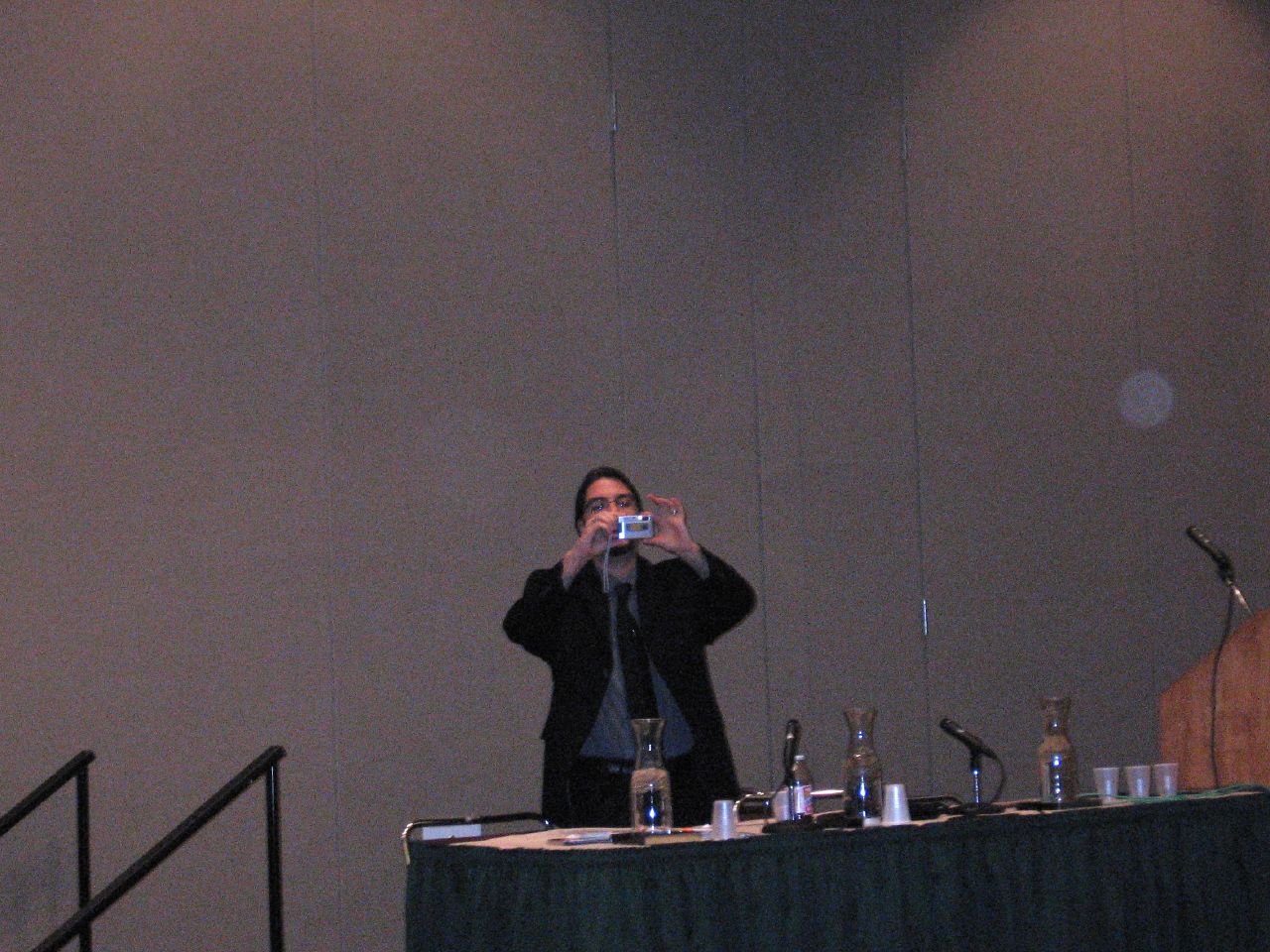
Michael Stephens started by taking a photo of the group. Here he is, I guess that in his, you will see me taking this photo.
One library uses Page Flakes as its start up page for all its public computers. He had some great examples including that the Library of Congress is using Flickr. Libraries need to be transparent, and need to talk in a human voice.
He talked about a lot of libraries including that Salt Lake Public will require that its new library director blog, Darien Public library has its circulation staff blogging.
Say yes to play! Hennepin County has done some great things as well. All of his slides will be up on his web site. Gwinnett County Public Library Flickr page is sort of a mini-web page. We need to throw out the culture of perfect.
Bring your heart to your job. We need to put a human face on library staff (which staff may not feel comfortable about -- editorial comment!) We need a carefully planned response to a changing world. Do it because you are meeting the mission and vision of the Library. How do we evaluate these new tools. In Australia there was a conference call on evidence-based librarianship. Have we reached an evaluation bypass? Singapore has a glass cubicle for cell phone users. Think about the library you are building for the future.
Michael closed with three thoughts:
- Learn to learn
- Adapt to change
- Scan the horizon
We tend to arc into the web and then find our way with conscious choices about where to go next in following links. Andrfew Keen's book is The Cult of the Amateur. We are moderates, Andrew Keen is an extremist. We need to encourage play and encourage the heart. Questions followed.
Thursday, March 27, 2008
Luncheon with Arthur & Pauline Frommer
The Thursday author luncheon I attended was the talk by Arthur and Pauline Frommer.
Arthur Frommer began his career in travel after
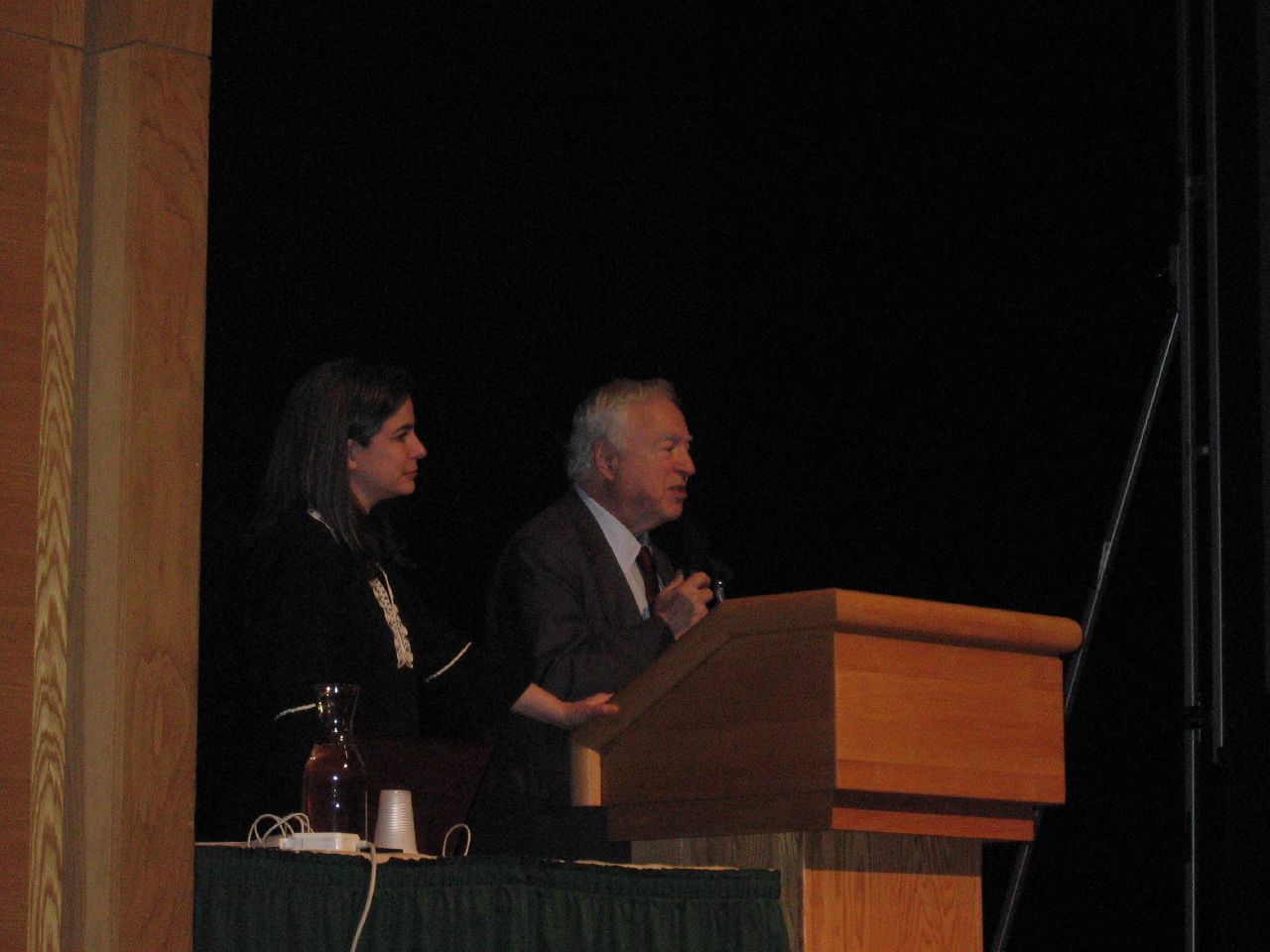
Arthur started with the typical library story including the importance of libraries in the success of his first book.
They talked as a team passing back and forth. They structured the talk as one on travel for librarians including trends.
Arthur started with trends:
Decline in value of US dollar. The value of the US dollar is at its lowest against the Euro and the pound. With commissions on currency exchanges, need to double the cost in Euros/British Pounds. Therefore must change habits of travel and eliminate
Elimination of the cruise ship as the option for the intelligent traveler. Ships are not a giant metallic box containing an amusement park. It now excluded the experience of ship travel. Smaller ships are still available, but are high priced for us.
The Internet now makes available the true costs of air travel through aggregaotrs who do not sell tickets like Kayak and Sidestep.
Pauline
Skyrocketing costs of hotels because of the lack of rooms. Price Waterhouse found that there were $2 billion in hidden fees after 15-20% increases. There are new fees and cancellation fees. Pauline writes budget guides which look at alternative travel. The series is aimed at travelers who want to travel with some dignity, but can’t afford the high price. For example, there are Londoners who will rent out a room with private bath. In many cases renting a complete apartment may be cheaper than staying at a hotel. In
Arthur
Thousands will replace trips to Europe with trips to Central and
There is an explosion of buses which allow you to travel in the
Pauline
Medical and dental tourism is a new field. With uninsured and underinsured, people are going to
Deals
Pauline: Sector tours is taking people to
Volunteer vacations can be good. National parks… Can be as little as $225 including meals.
Arthur
There is an immense bargain: a trip to
Pauline
Concluded with a slide show she featured places which are inexpensive, fascinating, under visited:
Appulia
They saved time for questions which ranged over topics like going to
Wednesday Morning PLA Notes
I did not attend the session I planned to attend for Session 2. Instead I went to the exhibits. As a PLA Board member I had the responsibility of visiting all of the exhibitors in one aisle of the exhibits. I was assigned Aisle 1900. My charge was to visit, and thank each exhibitor for choosing to pay to exhibit. I was thrilled that so many were having a great show, and some were already signed up for the next conference in
Wednesday Morning PLA NotesI did not attend the session I planned to attend for Session 2. Instead I went to the exhibits. As a PLA Board member I had
I did not attend the session I planned to attend for Session 2. Instead I went to the exhibits. As a PLA Board member I had the responsibility of visiting all of the exhibitors in one aisle of the exhibits. I was assigned Aisle 1900. My charge was to visit, and thank each exhibitor for choosing to pay to exhibit. I was thrilled that so many were having a great show, and some were already signed up for the next conference in
Subscribe to:
Comments (Atom)