Showing posts with label PLA Conference 2008. Show all posts

Monday, June 02, 2008

PLA -- A summary of the 12th National Conference

PLA in Minneapolis was a wonderful experience. I have long promised a summary. The State of Wisconsin, in its wisdom, certifies public library directors. I am currently certified, but to keep up my certification, I need to provide evidence of continuing education activities. I must complete 100 hours over a five year period. There are forms (of course) which are in the manual (Appendix F and G) . I must fill these out and submit them to my system. I did the 2007 CE reports for 23.5 hours. I will use this summary as part of my 2008 report.

I started PLA by attending Book Buzz, hosted by Nancy Pearl. While it has been a very long time since I did Readers' Advisory, I am still fascinated about the topic. Nancy did not talk a great deal, but served as the Master of Ceremonies for a group of publishers and representatives who talked in great detail about the new and upcoming titles from their respective firms. I picked up a couple of tips for titles to read. One of the panelists, Emily Cook from Milkweed Press, who was (correctly in my opinion) introduced as a "look-alike" for Winnie Cooper from the "Wonder Years." My most recent post was a review of a book which I received as a result of my interaction with Emily. A final reflection, I started getting incredibly excited about Readers Advisory at the PLA National Conference in San Diego in nineteen-mumble. Since then I have kept a sort-of-journal where I have recorded every book I have read since that conference. It helped me in my first years of Readers Advisory, and it is partly out of habit that I maintain it. In a way, the list on this blog is a public continuation and documentation of my reading.

The PLA opening keynote speaker was as much inspirational as informational. John Wood talked about his new mission of education -- which includes libraries! He noted that his goal is to reach 20 million children across the world by 2012. One of the more important points, that I think I knew instinctively, but had not ever spoken before was when John said: In the developing world there is no one who has done what Andrew Carnegie did in the US. One of the final notes which I took, is as true in this world (the "first world") as it is in the so-called "third world": You have to build “with” the people otherwise it is not sustainable. This is an incredibly important concept for librarians and library administrators (like me).

I started the next morning with the program Why We Borrow. This posting gathered the most comments (hey, for me, three is big!) of all my PLA posts. In a way, some of what was covered harks back to the old Baltimore County "Give 'Em What They Want" philosophy. That process took ideas from retail and applied them to libraries. Charlie Robinson was a leader in getting us, as librarians, to begin to think outside our library box. [In the quick search I did, this was the best I could come up with. Unfortunately, Charlie was pre-Internet.] This program also validates something I have learned that ALA is doing as part of its efforts to improve the ALA Conference. At one or another of the recent meetings, ALA had some specialists watch videos of the behavior of we librarians on the ALA exhibit floor in an effort to better understand our behavior. We need to think about doing the same for our public as they visit our facilities. This is a huge difference from the way we currently act!

Lunch with the Frommers was fascinating. They talked about the travel industry and some of the places which are still bargains. Who doesn't want to travel. Will I get to any of those places? Likely not, but that does not mean that I can't dream. As I started to compile this, I got to thinking about the one question never asked: how does it feel for father and daughter to work toether? As much as I l0ve my daughter, I could not imagine being in that kind of situation!

After lunch I went to So What? Using Outcome Measurement to Assess the Impact of Library Programs. I have been around long enough to remember the introduction of PLA's "Output Measures for Public Libraries." This concept takes the output measures to a new level. While I understand and appreciate the importance of "outcome" measures, it goes against some of my librarian training to get to that level. Output measures uses quantifiable results of "inputs" (like budgets). "Outcome" measures means that you have to, in my opinion, get into the lives of our users to find out what they did with what we, as librarians, have given them. It is an important concept, but I think that the concepts of patron privacy have become so deeply ingrained in me that I resent the need to ask our users about how they will use our outputs, that I get really antsy. Is the next step to judge the "worthiness" of our serving some users? This is an interesting concept which will challenge administrators and freedom to read advocates!

For me, the program on outcomes was followed by a much more practical program on surveys. For any library preparing for strategic planning (as is LEPMPL), the concepts of valid community surveys is critical. We often know what our regulars want, but what about the occasional user, or better yet, what about the non-user. It is surveys of the latter which most interests me as an administrator. While I believe that there is a certain segment of the population which we can never effectively serve, I think that we can probably reach those in the margin -- i.e. those non-users who we just have not reached, but are willing.

Cutting Edge: The Latest Info on Web 2.0 started with a presentation from someone at one of my former libraries! It was great to see some photos of places I recognized and had worked! Much of the program was about how to integrate new technologies into our regular, daily work. Some of my favorite "2-point-0-ians" were on the panel including Michael Stephens and John Blyberg. How I wish I could be as bright as they are about connecting public libraries and users!

Who doesn't love an author? And an author who owns and runs an independent bookstore is a huge bonus. Well, that is Louise Erdrich! Her newest book, a souvenir of lunch, The Plague of Doves, is sitting just waiting to be read. It is incredibly hard to capture an author reading the words that they have written. Suffice it to say, it was inspiring!

Sponsorships are the wave of the future for libraries. (Look at municipal stadiums and taxpayer-financed professional ballparks!) A panel discussed the ins and outs of sponsorships. Here are some hints: be sure to spell the sponsor's name correctly, have rules in place (in advance), plan in advance for what you will ask, don't always expect cash. Sponsorships will soon be the lifeblood of library marketing, especially if you do not have a large budget for marketing. I have learned that already!

One of the best programs I attended was Let’s Get Married! Bringing Friends and Foundations Together to Raise More Money. The relationship among library staff, Friends groups, and foundations are among the trickiest in the library world. Everyone has an ego, we need to pay attention to each other and maximize our funding potential. One of my true heroes in this arena is Peter Pearson of the Friends of St. Paul Public Library. Truly one of the huge advantages of my current position is the proximity to St. Paul and the ability to watch him more closely! There is an incredible wealth of information on the PLA Conference site (#238).

Another great program was presented by my friends Past ALA President Pat Schumann and Kathleen Imhoff of Lexington (KY). The program was on marketing without a budget. Kathleen's presentation included 10 easy steps to start, and there were some really great ideas from the audience. It was the perfect example of a great, interactive program which is hard to capture here (or in words anywhere). The best thing, is that it is easy to do!

The second to last program I attended was both in a more humorous vein, but also included some great reader's advisory ideas. It was called Superheroes to Serial Killers: Librarians in Literature. As part of the presentation there was a segment called "Serial Killer or Librarian" where a series of photos were projected and the audience was asked to pick one or the other. It was fun, and humorous. My original post includes a link to the reading list -- a must for librarians!

Paula Poundstone was the closing keynote speaker. It is really hard to capture the spirit of a stand up commedienne. Paula is one of my favorite panelists on Wait, Wait, Don't Tell Me (well, after my high school classmate, and original panelist Charlie Pierce...I walked to high school with him!) Some of the presentation was prepared, but clearly parts were not, as when she "picked on" California State Librarian (and PLA Past President) Susan Hildreth. I think that Paula may have been surprised at both our moxie and at the level and type of public librarian represented.

Overall---it was a great conference. As I said at a meeting today, one of the key things about the PLA National Conference is that it is all content. There are no business meetings, it is all programs and exhibits! Too bad I cannot get credit for going to the exhibits...it has been a while since I have had time for that at ALA conferences!

Wednesday, April 30, 2008

Urban development -- a perspective after PLA

I have been subscribing to the email newsletter "Shelf Awareness." In today's issue is an article about the Open Book store in Minneapolis. Now, while I am a latecomer to the upper Midwest, and certainly don't know what the neighborhood used to be like, I did have the opportunity to visit for a reception at the PLA National Conference.

It is a great store, it houses several (?) small presses, and has an incredible workshop for printing. There is a cute gift shop which I also patronized while there, and there is the now-required coffee bar.

I encourage a visit!

Tuesday, April 08, 2008

PLA -- Humor

Yes, I know I still owe an evaluation, and it has been percolating in my head a little. However, I have to share this which was also in American Libraries Direct. It is my excuse to figure out how to embed a video.


And I think I got it!

Monday, March 31, 2008

Paula Poundstone -- Closing Keynote Speaker

Later this week, I will do a reflection piece on PLA in Minneapolis. This is my las "report" of a session.

Paula Poundstone was the closing keynote speaker. While some of what she did was part of her regular stand-up routine, she did a great job talking about and to us. During her show, she did "pick on" some of the audience members and asked them questions, including about their personal education and most importantly when they knew that they wanted to be a librarian, and why.

One of her early choices of audience members was Susan Hildreth, a past PLA President, and the State Librarian of California. The interchange about how Susan was chosen and appointed by the Governor ("the Governator," Arnold Schwarzenegger) was hysterical.

It was a great closing to a great conference.

PLA President Jan Sanders reported that total attendance for th conference was over 9,800! A huge success.

Saturday, March 29, 2008

Superheroes to Serial Killers: Librarians in Literature

Started with his doing talks on readers advisory and threw in books which included librarians. They were always the most popular with the audience -- even when librarians were not in the audience.

Everything is on the handout.

Michael Gannon @ Prince Georges County Maryland

Objectives for all activities in Maryland, and Michael listed his objectives. Talk was rated PG-13 because of the "racy bits."

Famous Librarians quiz...very humorous. First answer was was Hypatia of Alexandria. St Lawrence was the second, as another patron saint of librarians. (Roasted alive was the key clue.) Casanova got a huge laugh. Pope Pius XI was a librarian. Chairman Mao made the list also. J. Edgar Hoover worked at the Library of Congress.

He then talked about stereotypes including the clip from It's a Wonderful Life and the Bacardi ad: Librarian by day, alcoholic by night! Batgirl and Captain Comet were librarians. He included librarian blogs including the Lipstick Librarian and her Cafe Press products. He noted the Modified Librarian. He noted the Wyoming Library Association campaign with the mudflap girl campaign.

He then went into librarians in literature, starting with Librarians in Fiction which he referred to as "incredibly dry." In the Stacks is a collection of short stories. One of the stories features TV's Mr. Ed.

He finally got serious with Miss Zukas and the Library Murders. And continued. What is missing from the handout is the wonderful covers and incredibly snarky remarks on books and covers like Nympho Librarian.

He ended with a little game called: Librarian or Serial Killer with some amazing photos.

[This was a wonderfully entertaining speaker.]

Marketing without Money

[I will revise this post next week!]

The program was organized by ALA Past President Pat Schumann, and had as the main speaker was Kathleen Imhoff, Director of the Lexington KY Public Library.

I sat next to Kathleen at dinner last night, and have known her for years (we serve on an ALA committee)

  1. Neaten Up
    Look around the building. Look at all the signs. Make it a goal to take down 5 signs every day!
  2. Secret Patron
    Get someone who has not been to the Library in a while to come in and look around and share their perspectives with you.
  3. Increase Staff Training
    When staff are at the desk and not waiting on someone, what are they doing? If they are doing “off desk” tasks, they do not look approachable.
  4. Form New Partnerships
    Look for partners in the community, the Chamber of Commerce
  5. ???
  6. Join Community Groups
    This is a great way to get your message to key community leaders. Library Directors and
  7. Partner with PR Firms
    Even in the smallest community, you have someone who has a connection with someone in a public relations firm.
  8. Barter
  9. Grocery Store Line
    Talk to people in the line without identifying yourself as working at the library. It is stealth marketing. Kathleen did not call it this, but it is a way of viral marketing. This would apply to any place where you are waiting in line. Ask your staff to do this.
  10. Change or Revise Image
    Use name tags, use cheap (Oriental Trading Company) beads to hang name tags.

Message

Various members of the audience shared messages. One that caused some chuckles was “Your Library is Free and Easy!”

The message needs to be short and “punchy” there is information on the ALA web site. Pat Schuman shared a Message Worksheet. It needs to speak to the listener, not to us! The message needs to be very clear. Need to have a short message and then have a longer “elevator speech.” (For those not familiar with the elevator speech, it is a brief talk that you would give on a short elevator ride – i.e. no more than 2 minutes.

Low cost marketing opportunities:

For a small amount of money (e.g. bookmarks) consider going to the local bank (if you still have one).

Take a zip lock bag, put the two sided brochure to display or hand out with bookmarks and brochures. They can be used over and over. Or you can buy printed plastic bags for events. More people will take a bag of “stuff” than will a brochure or bookmark.

Combine messages by doing things like printing black and white on one side, and color on the other. Kathleen also had a brochure with tear-off/cut-off bookmarks on the end. For about $0.25, new baby bibs with message: Read to me! Lexington got a health care firm to underwrite the cost of the bibs (and without the logo).

Kathleen talked about her book Library Contests published by Neal-Shuman. Pat Schumann offered a discount to attendees.

Other ideas included chalk art to advertising programs, including having the teen advisory board doing the art. Pharmacy bags or promotions with grocery stories.


We must evaluate any activity. What does success look like? Did that promotion get more people? To find out some of the answers, we may need to ask people.

Let’s Get Married! Bringing Friends and Foundations Together to Raise More Money

Donna Bero, Executive Director of the Friends of the San Francisco Public Library, introduced the program and gave an overview of the goals of the program. Friends group started in a fairly traditional way in 1966. When new SFPL Main was needed, the Friends did not think that they could raise the money so they created a foundation. After the building was complete, the two organizations merged over the course of six years. Now, they raise money for capital projects ($16 million for furniture), provide programmatic support, do advocacy for the library, and have their own book operation including two stores and a major sale each year. They do literary events.

Anita Duckor, Executive Director of the Friends of the Minneapolis Public Library The Friends group was founded in 1949, over 5,000 members. They were born out of the need for advocacy. This year raised $450,000 for MPL. The Friends have evolved from being an adjunct to being essential. Raise significant capital dollars and have two book stores. The one consistent thread has been advocacy. Administer three key cultural programs: Talk of the Stack (current literature); People’s University (lecture series by university professors); Classic Film Series. Now under a new system with the consolidation of Hennepin County Library and the Minneapolis Public Library.

Peter Pearson, President of the Friends of the St. Paul Public Library, started with jokes about St. Paul and the relationship with Minneapolis. Friends was founded in 1945 by the Library Director. It was a typical Friends group. Kept the same feel until 1973, when Dr. John Briggs wife fell ill, and Friends brought books to her. He left his estate to the Friends. The estate was worth over $2 million at the time. This caused the change from a traditional group to more like a foundation. They worked with the Community Foundation closely. This worked until 1991 when there were cuts. Peter hired in 1992 to increase the endowment and advocate. The endowment is now $15 million and there is a staff of 6. They do fund raising, grant writing, capital campaigns, planned giving along with corporate sponsorships. They do a great deal of advocacy, the budget has increased every year. They also do programming, until recently it was 100%, new director wants more staff involvement. Not physically located in the Library, because it makes it clear that the Friends are not library staff.

There is a white paper posted on the PLA Conference site.

Three models:

  • Stand alone Friends Groups
  • Stand alone Foundation
  • Merged Friends and Foundation

All three represent the latter, so the presentation may have a bias.

Most stand alone Friends groups do not have staff. Foundations often recruit prominent people to serve on the board, Library Foundations will move to a staff model There can be some turf issues, the groups need to share databases. How big donors are treated.. There is only one Board.

There is clear communication to donors. They do a membership campaign and other fundraising coordination. The broader mission attracts a broader membership. There is name recognition confusion. They are free-standing and can sometimes seem to independent of the Library. Joke: “The average age of our Friends group is deceased!”

It takes resources to support the organization as well as the library.

Gave examples from each organization.

Minneapolis: in 2000 referendum passed with 67% of the voto. Had three trustees appointed to the Friends Board. An environment of competing institutions, Raised $16.5 million. Actually did as individual library campaigsn Notes and slides are on the PLA web site.

Selling a Sponsorship without Selling Your Soul

There was a panel of local business representatives moderated by Wendy Mouglan of the Friends of St. Paul Public Library. The panel members were: Dot Beltsler, RBC Wealth Management; Patricia Effenberger, Pioneer Press; Ceace Haagensen, Xcel Energy

All of the handouts are online.

The panel members took turns addressing questions which were asked by Wendy Mouglan. Some random notes from the panel: Do your homework, make sure to spell the name of the company correctly.

Should think beforehand what the sponsor is likely to be able to do. Media people are not likely to give cash, will give “in-kind” and can be used with other sponsors to show recognition. It also helps by showing support. One key feature is to have an employee involved.

How far in advance do you ASK Will vary year-to-year. In the fall, many have other fund, get to them early. Bring the idea to the busness. At least 6 months a in advance or longer.

Networking is key for everyone, and the key executives want to been seen in the company of other executives. They are looking for different events. Logo placement is important. Exclusivity is important.

Louise Erdrich

I attended the luncheon where Louise Erdrich spoke. I find it tough to "cover" an author talk, especially one where the author reads. I enjoy them, but it is hard for me to relay the flavor of the event, and the energy in the room. In addition to being an author, Louise owns Birch Bark Books in Minneapolis. There were advance readers copies of the Plague of Doves on the tables. As is so often true when non-librarians speak, she began with the obligatory library love story and noted that she was raised by two school teachers.

She then read a “tiny little piece” that it the part of the The Painted Drumk that she gets the most letters about . After that she told growing up stories including of going gathering with father hunting. She then read fr0m the letters she has that her father has sent her.

She ended by reading a section of the new book about leaving home for college.

Friday, March 28, 2008

Cutting Edge: The Latest Info on Web 2.0

Jen Maney from the Pima County Public Library. Web 2.0 allows libraries to interact with customers and meet today's need today. Web 2.0 is the second generation of the web and focused on the social. The virtual library has a motto "Designing for uncertainty." Accepting that the future is uncertain. There is no right and no wrong there is only change.

(She had a great PowerPoint with simple slides for which she spoke a great deal about each one, and the slides were dynamic and interesting. One of the best PowerPoint presentations ever!)

Have slide shows on the web site with Fickr wrapped in the web design. Teens are doing videos. It is reaching them because they are voting and commenting on the videos on You Tube. Not everything is successful 2.0 is about my life, your life, our life! When it fails, take it down!

Use people on the web site, in the program. The Technology Team plays....need self-proclaimed Luddites for new technologies, because that makes techies really explain what they are doing and why. You can't do it all, you need to have a team and start to focus. Can't do everything that is new. Starting to use 2.0 technology with staff, including heavy use of a wiki.

Have learned that web based participation is higher when it is connected with an regular library program.

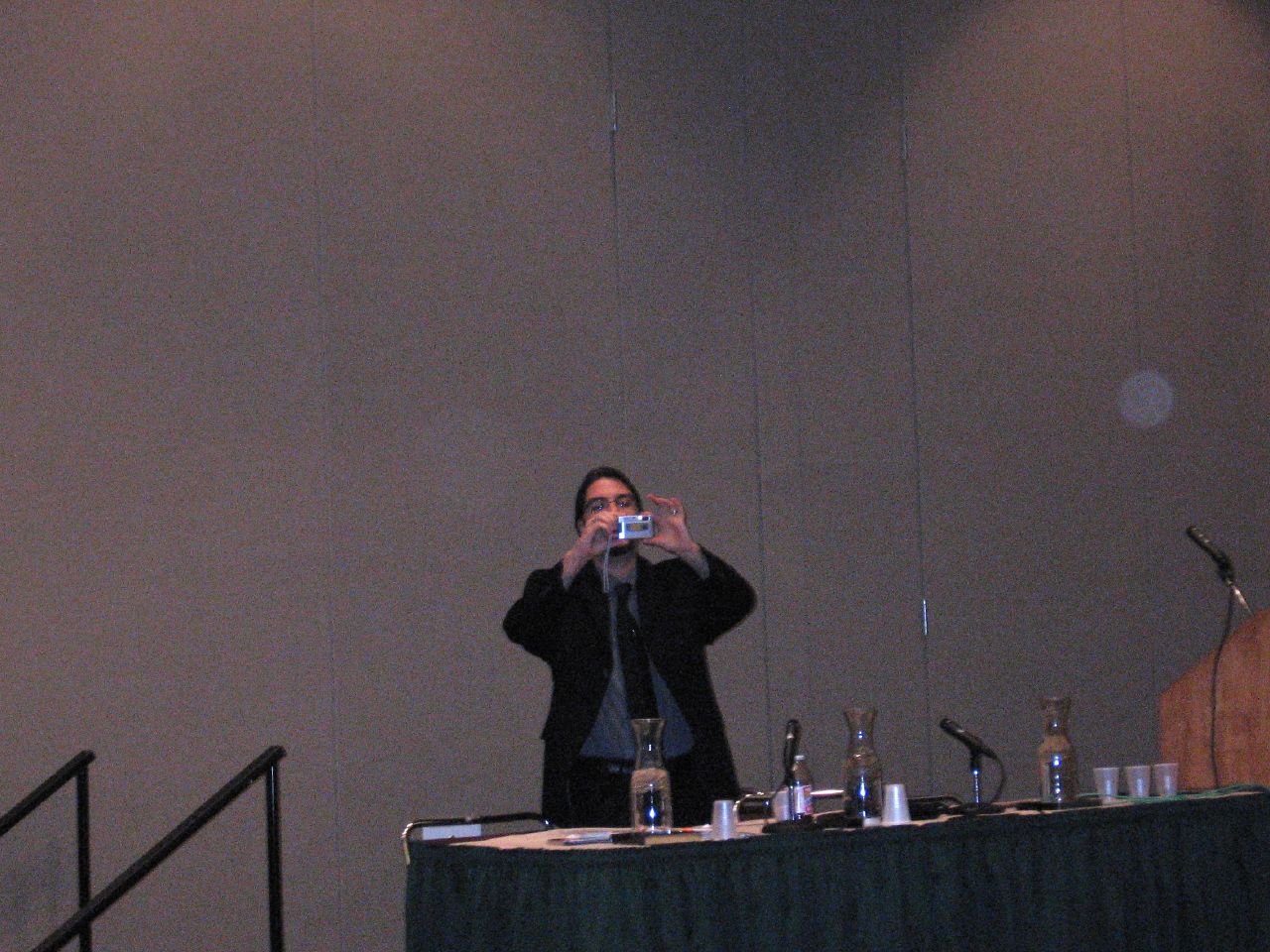
Michael Stephens started by taking a photo of the group. Here he is, I guess that in his, you will see me taking this photo.

One library uses Page Flakes as its start up page for all its public computers. He had some great examples including that the Library of Congress is using Flickr. Libraries need to be transparent, and need to talk in a human voice.

He talked about a lot of libraries including that Salt Lake Public will require that its new library director blog, Darien Public library has its circulation staff blogging.

Say yes to play! Hennepin County has done some great things as well. All of his slides will be up on his web site. Gwinnett County Public Library Flickr page is sort of a mini-web page. We need to throw out the culture of perfect.

Bring your heart to your job. We need to put a human face on library staff (which staff may not feel comfortable about -- editorial comment!) We need a carefully planned response to a changing world. Do it because you are meeting the mission and vision of the Library. How do we evaluate these new tools. In Australia there was a conference call on evidence-based librarianship. Have we reached an evaluation bypass? Singapore has a glass cubicle for cell phone users. Think about the library you are building for the future.

Michael closed with three thoughts:
  • Learn to learn
  • Adapt to change
  • Scan the horizon
John Blyberg, formerly at Ann Arbor and now at Darien (CT) Library, was next. His talk was called "Keen on 2.0: The Amateurs are Coming." Andrew Keen writes that every few centuries there is another great seduction. The last was communism. The new one is digital utopians. He had some great paraphrases of Keen's comments. He had the actual quote and a snarky translation, like "You sexy commies!" "Karl Marx -- a playa" "You might be boring" "You barbarian horde!" (I hope it puts the slide show up on the web! He gave a link, but they are not here yet.)

We tend to arc into the web and then find our way with conscious choices about where to go next in following links. Andrfew Keen's book is The Cult of the Amateur. We are moderates, Andrew Keen is an extremist. We need to encourage play and encourage the heart. Questions followed.

Ins and Outs of Community Surveys or Library Surveys 101

Donna Fletcher
  • Why conduct?
  • Setting objectives.
  • Options.
  • Planning
  • Designing the survey
  • Survey Sampling principles
  • Good report

Why? Get the perspective of your community, more than just the library users. It is often different than those working there or even the Board! This is an 0pportunity to gain info on many topics including new services.

How are you going to act on the results? This will help determine what you ask. Fuzzy objectives lead to fuzzy research. Examples: gauge current satisfaction; determine desirable features in an expanded facility; understanding what the community is willing to spend.

Good research requires specific objectives.

Options include quantitative (surveys) and qualitative (focus groups, individual interviews).

Quantitative research counts “how many:” What are the results.

All legitimate surveys try to reach two goals: reliable, represent the population demographic of population sampled

Make the questionnaire as easy as possible,

Ask valid questions

A good report provides insight, conclusions and potential actions.

Thursday, March 27, 2008

So What? Using Outcome Measurement to Assess the Impact of Library Programs

Rhea Rubin was both the organizer and speaker. Her book is available from ALA [ link updated 10/2025]. She wrote the book under contract, and does not receive royalties. [These are notes based on the speaker's remarks, and not my comments...which will be clearly noted.]

Crime rates have gone down in many cities, a recent newspaper article said that police departments are reporting to citizens what they are doing differently to reassure the need for police services. In addition to the statistics, the are trying to a "here's the effect of our work." So what is that result? They are reporting a reduction in crime and tying it all together. For example, neighborhood policing may be a reason. Others may not be reporting a reduction because of vacancies. This is outcome measurement. Outcome measurement is the reporting of the effect of our efforts.

United Way pioneered in this area. For example homeless shelters are supposed to report what happens to the people who use the shelter. In libraries, do people who get correct health information have a better health outcome? Perhaps they ask different questions of their doctor or other health care professional.

The first handout to look at should say Outcome Measurement Key Concepts [this one is not on the web...yet, but it will be]. We are used to dealing with inputs like money, staff, volunteers, etc. Answers the question which of our inputs do we use to achieve a goal. Outputs are a measure of what we do. It is an answer to the question "How much did the library do?" Outcomes are what happens to a user because we had inputs and deployed them to help a user. "What difference did our program make to the customer?" Inputs and outputs are about efficiency. These are also very much staff perspective numbers. Outcomes are from the user's perspective. What are key results.

How can we ever know the outcome from the general circulation of books. Outcome measurement does not work very well for a broad and general category. It is best used with relatively small programs and services which you can then look at as a whole. Outcome measurement is something you do at one point at a time and may not ever do it again, or perhaps five years later to measure change. To try this look for a program which has been designed to address the needs of a specific group of users. Look for a program that affects a specific person rather than producing a product. It is critical to pick a program where the people come more than once.

In Planning for Results they suggest specific kinds of statistics to measure: output measures; process measures (combines input and output measures), and outcomes.

Outcome kind of question:
  • And what will you do with that information?
Ask not only what do users need, but what will they do with that information. Takes anecdotes and uses them as the basis for analyzing our work.

May sometimes use output measures instead of outcome measures. The latter measures the impact not just the efficient. A program can be more effective if not efficient.

Luncheon with Arthur & Pauline Frommer

The Thursday author luncheon I attended was the talk by Arthur and Pauline Frommer.

Arthur Frommer began his career in travel after Yale Law School when joined the military. He wrote A Soldier’s guide to Germany this was later republished as Europe on $5 a Day in 1957 and became a best seller. There are now over 300 titles in the list. Pauline is his daughter, writes on her own, and started the Frommer web site.

Arthur started with the typical library story including the importance of libraries in the success of his first book.

They talked as a team passing back and forth. They structured the talk as one on travel for librarians including trends.

Arthur started with trends:

Decline in value of US dollar. The value of the US dollar is at its lowest against the Euro and the pound. With commissions on currency exchanges, need to double the cost in Euros/British Pounds. Therefore must change habits of travel and eliminate Europe and replace it with other equally interesting areas of the world.

Elimination of the cruise ship as the option for the intelligent traveler. Ships are not a giant metallic box containing an amusement park. It now excluded the experience of ship travel. Smaller ships are still available, but are high priced for us.

The Internet now makes available the true costs of air travel through aggregaotrs who do not sell tickets like Kayak and Sidestep.

Pauline

Skyrocketing costs of hotels because of the lack of rooms. Price Waterhouse found that there were $2 billion in hidden fees after 15-20% increases. There are new fees and cancellation fees. Pauline writes budget guides which look at alternative travel. The series is aimed at travelers who want to travel with some dignity, but can’t afford the high price. For example, there are Londoners who will rent out a room with private bath. In many cases renting a complete apartment may be cheaper than staying at a hotel. In Europe there are monasteries and convents which rent rooms.

Arthur

Thousands will replace trips to Europe with trips to Central and South America. He talked about going to Chile, a country run by a woman. Buenos Aires has a great lifestyle where the peso has dropped from par to 3 pesos to the dollar. Costa Rica has been found, but there are places like Panama City and to Nicaragua. The Panama Canal has had its volume of ships tripled under the new management of the Panamanians. There are lots of low cost bargains, and no jet lag since they are in the same time zones as parts of the United States.

There is an explosion of buses which allow you to travel in the US at very, very low prices from $1 to $14 between cities. The mob scenes and travel through airports are difficult, and Congress has starved Amtrak so that train travel is unattractive. There are new entrepreneurs who have undercut the prices of Greyhound by up to 60%. Some include free electricity and wi-fi. Megabus has been launched and offers very low costs.

Pauline

Medical and dental tourism is a new field. With uninsured and underinsured, people are going to Costa Rica, Brazil, and Thailand to get care. The same organization which accredits US hospitals is accrediting hospitals around the world. The level of care is higher because wages are lower and the number of nurses is double the US level, and cleaning staff will be four times the level of US hospitals. Costs are lower both because of lower wage rates and subsidy by the government. Different countries have different specialties: plastic surgery in Brazil, heart surgery in Thailand

Deals

Pauline: Sector tours is taking people to Ireland for $799 in April and returns in November and December. The Caribbean in hurricane season can be much cheaper in September and October. In Dominican Republic an all inclusive vacatikon travel mart, liberty travel

Volunteer vacations can be good. National parks… Can be as little as $225 including meals. Vaughan systems teaches Spanish business people to speak English. Need to pay your way to Spain, but for free, you get hotel and meals. All you have to do is talk, so that the business people can learn colloquial English.

Arthur

There is an immense bargain: a trip to China whose currency is artificially weak against the dollar that the cost of a hotel can be $30 in a tourist class hotel. China Focus (chinafocus.com) for a 10 night stay including airfare and visiting 5 cities and escorted tours. $999 per person in the winter, goes to $1399 in the spring. Others who offer similar tours from the East coast include chinadiscovery.com or chinaspree.com. Costs will be high during the Olympics, but within 5 days of the end of the Olympics, prices will drop again.

Pauline

Concluded with a slide show she featured places which are inexpensive, fascinating, under visited:

Molokai
Appulia Italy (the heel of the boot of Italy)
Halifax, Nova Scotia

They saved time for questions which ranged over topics like going to Vietnam, Greece, and cheap flights to Hawaii. (Kayak was noted as the best site for finding cheap flights.)

Wednesday Morning PLA Notes

I did not attend the session I planned to attend for Session 2. Instead I went to the exhibits. As a PLA Board member I had the responsibility of visiting all of the exhibitors in one aisle of the exhibits. I was assigned Aisle 1900. My charge was to visit, and thank each exhibitor for choosing to pay to exhibit. I was thrilled that so many were having a great show, and some were already signed up for the next conference in Portland (Oregon) in 2010. Several noted that the attendance on Wednesday night was great! One suggested having more food in the exhibit hall to entice conference goers.

At the luncheon, PLA President noted that at that moment (noon Thursday), attendance is at 9,418 (including exhibitors). She hopes that the total will exceed 10,000 (a personal goal)!

Wednesday Morning PLA NotesI did not attend the session I planned to attend for Session 2. Instead I went to the exhibits. As a PLA Board member I had

I did not attend the session I planned to attend for Session 2. Instead I went to the exhibits. As a PLA Board member I had the responsibility of visiting all of the exhibitors in one aisle of the exhibits. I was assigned Aisle 1900. My charge was to visit, and thank each exhibitor for choosing to pay to exhibit. I was thrilled that so many were having a great show, and some were already signed up for the next conference in Portland (Oregon) in 2010. Several noted that the attendance on Wednesday night was great! One suggested having more food in the exhibit hall to entice conference goers.

At the luncheon, PLA President noted that at that moment (noon Thursday), attendance is at 9,418 (including exhibitors). She hopes that the total will exceed 10,000 (a personal goal)!

Why We Borrow! Redesigning Libraries by Learning from Successful Retail Practices

Ann Marie Luthro from Envirosell was a great presenter. She was used to dealing with corporations and not non-profit/governmental agencies.

The key is to study what happens in the box. It is a maze and the customer is a mouse. Watch the maze and the mouse. There are different kinds of mice. They want to get through the maze to get their thing. Nobody can make you buy stuff. You are in the store because you have a need.

There are three primary reasons people come to the library (and they vary a little bit from library to library). You have to know the primary destination.

Methodology is to watch. All of us are slightly voyeuristic. There is a pool of trackers who go around the country and watch people. Typically this is done in a store. Also look at how product lines sell at different stores. There are also some service studies.

In addition to watching, also video customers and pay attention to the behaviors. Shows certain things. Video really brings home the actions and reactions. She showed a video clip to demonstrate her point.

Libraries are the last "local." They were one of the first town meetings and one of the last ones standing. In America we are looking for "home" or a third space within a short drive or a walk, and we (libraries) have it.

Does your staff have an indication that staff speak another language. [This may not be a big issue in Eau Claire but in other communities it may be!] Libraries are the only place trying to reach out and teach and educate. The only face of public service in this country.

Majority of shoppers/customers enter the place alone, second most is in families (moms with kids). On the rise is a group of friends. In libraries this is often young people coming in to use the Internet. Teen rooms for about 10 people are not meeting their needs to have physical activity. If you allow "roaming, free-range teenagers" you need to think about proximity to other services.

Space is gender neutral, which is incredibly unusual. Almost every retail environment skews female. Now, this is changing, there is a growth of men in retail. Women still shop for fun.

Frequency of visiting is on par. Frequency of visits are closest to Starbucks, then supermarkets, and then Walmart. What do we need to do to take care of people who visit more than once a week. We cannot just ignore them and assume that they know what is where. Have to keep them coming. The borrow rate is not on par with the visit rate is because the PC is not checked out.

Why do people visit? All over the place because ethnicities are all over the place. That is different groups use the facility differently. Average number of items checked out is almost 5. The dollar value of the basket is very high, and would be coveted by most retailers.

Length of visit was a surprise. Trackers were set up thinking that the visits were long. 93% spend less than half an hour. However, length of visit is still higher than other retailers including Walmart and supermarkets, but also home stores.

The myth in retail is make them stay longer, and they will buy more. That is not true, it ties up staff time. The goal is to make the most of the time spent in the library. Visited three "macro sections" within the building: books, media, and computers.

What is measured: where is the first place they go? what do they look at? In libraries customers tend to head straight to section. Many come in with a sense of urgency (get ahead of other friends...) Need to build entrances more strategically. Get out from the desk. Ask questions on the floor. Recognize people, talk to them about what it is that they are checking out.

People are not asking questions, so don't put the info desk right there. She then went through some slides

Signage Think about these three things: Who needs the information? What are they doing/how are they moving? What information do they need?

Keep important info at chest level, and signs need to be in large enough type. Use odd shapes and sizes to get people's attention. We are used to square shapes and corners, and libraries are full of square shapes and corners. It is important to have a sense of movement ("theater").

America is changing and evolving and we need to also. The types of services being used are changing. Not necessarily good or bad, but media and PC use are increasing. What does it mean when circulation drops? We need to change how we measure our return on investment. People will "look it up online" and we may lose people.

Libraries are local and should reflect the local culture. If you have a coffee cart you need napkins and trash cans and people to take care of them. REI has staff who "live the life" and we need to borrow that idea.

The librarian scheduled to talk about San Jose (Mary Nacu) was sick so the program organizer, Lisa Rosenblum, presented the PowerPoint. She did a great job.

Do believe in self navigation, and do a great job of signage. Do zoning and assign staff by zones, not just for librarians, but for assistants as well.

Need to know your customers. That is not stereotyping to plan for things like mothers with strollers, it is a sign of good design.

Some users need help using libraries. Used colors to brand the children's section including slatwall and face out shelving. Style of sign matches activity. Also, clear up the clutter!!! (Every library can probably do this!) In Hayward, they also "de-signed" including putting the DVDs at the front and then did not put up signs! What a concept!

[There were no dowloadable handouts from this program.]

Opening General Session

I walked into Hall E, and felt immediately blind. It was bright in the hallway, and there were almost NO lights on in the Hall. I nearly ran smack dab into someone who stopped to take off her (black) coat, and I could not see a thing, Even sitting for about five minutes, I can’t even see the keyboard! [At last those touch typing classes are paying off!]

I am starting to get annoyed because the event was billed as starting at 2:30 and here it is almost quarter until 3 and there isn’t even anyone at the podium. I have to dash out early, so the longer they wait to start the less I will get to blog! On the screens (and there are six of them) are ads. Four are one shot and the other two are a different set. I am guessing that the four will have a projection of the speaker(s) and the transcription will be on the smaller pair. The good news is that at the back of the room there are bleachers with seats with arms.

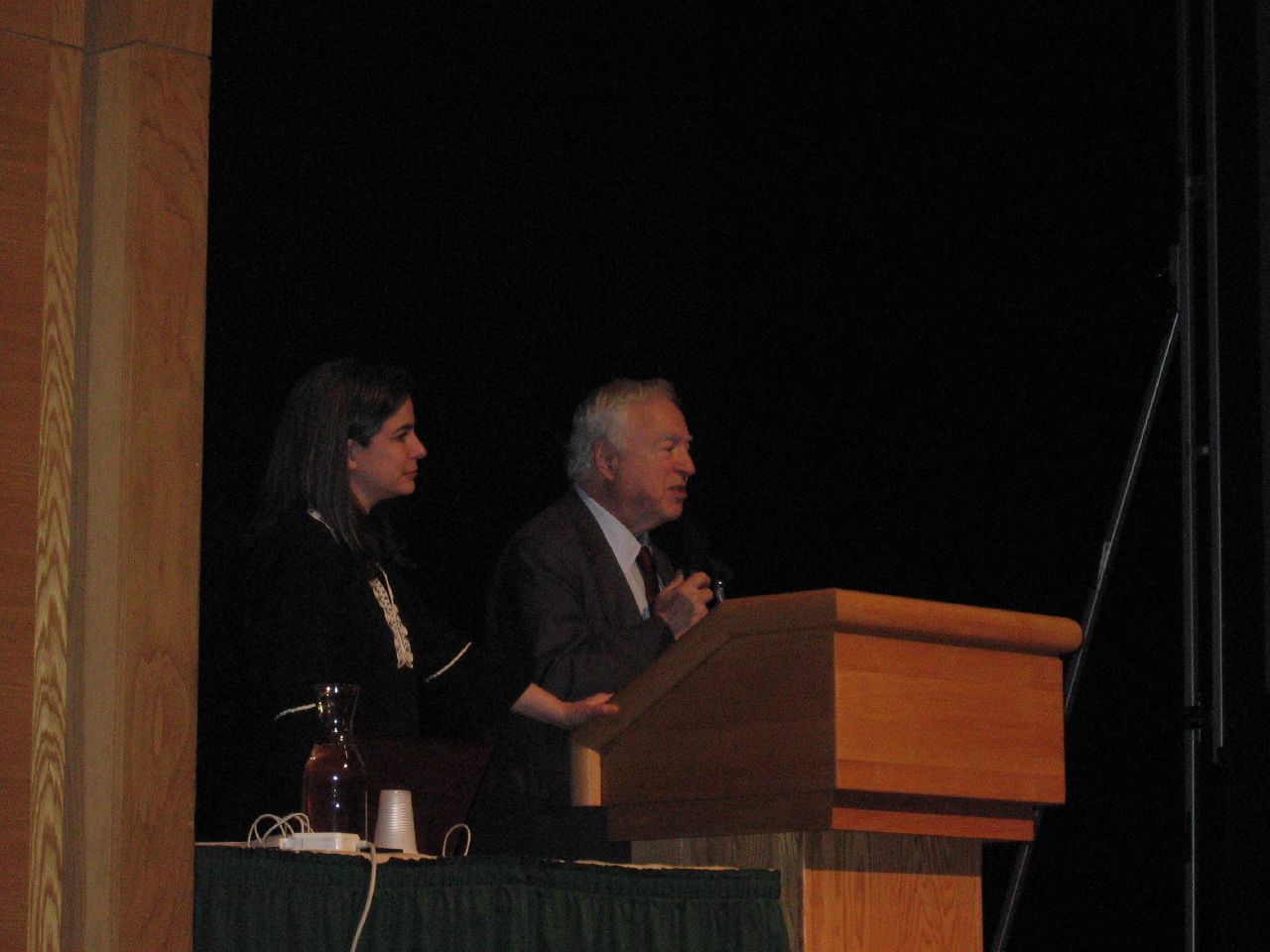
Jan Sanders started out with jokes about having left Pasadena at 74 and arrived here with the temp at 19 and it was snowing! Of course this is the winter which seems like it will never end.

John Wood, trekking through Nepal he visited a school where there were 20 books for over 400 students. So he started to work setting up libraries across the world. He left Microsoft at age 35 and set up Room to Read, heart of Mother Theresa and the scalability of Starbucks. Since 2002 has set up libraries around the world.

His book is titled: Leaving Microsoft to Change the World. As is so often true he started with a library story and he loved his librarian. He considers himself an accidental philanthropist and accidental librarian. He actually go the title for his book before Bill Gates.

Every child on earth should be educated. How big to we dare to dream. Dare to dream bigger. World change starts with educated children. Education is a hand up not a hand out. Goal is to reach 20 million children across the world by 2012,

Went on trek to escape from work, and the leaders of Microsoft. Met a gentleman who invited to visit a school more than 2 days from the nearest paved road. Bridges are very scary especially if you have vertigo.

Library was a big empty room, no books! Books were in a locked cabinet because they were worried that the children would harm them. But the books were ones which had been left behind by trekkers. “Perhaps sir, someday you will come back with books.” One teacher was skeptical and said, many people have promised to come back but have not. Thought about the situation for the next 16 days. Vision that he would be come the Andrew Carnegie of Nepal.

Took for granted that the library was always there. In the developing world there is no one who has done what Andrew Carnegie did in the US.

Delivered 3000 books and because of the reaction, quit Microsoft to bring books and education to kids. Education is the number one way out of poverty. It is the best way to empower women and women and girls are the ones mostly left behind (in the economy).

Attack 3 problems:

  • 110 million children who should be enrolled in school who are not in school;
  • 800 million people cannot read or write, one out of seven people;
  • 2/3 of these are females

In the developing world school fees, uniforms etc are normal and usually the eldest son is the one who goes. This is not a woman’s issue, but an issue that men need to care about and do something about.

Discussion of what doing and how doing. Empowering local teams. Raise money here and let the locals deal with the local government; they are the ones who make the project sustainable. GSD – get stuff done.

Engage community through challenge grant. Will help you realize the vision of a school or library. You can only people who want to help themselves. Have to build “with” the people. See web site.

Book Buzz hosted by Nancy Pearl

Nancy started with a story about being stuck on a long flight with only two books which she hated. She suggested a contest: to create a single word [presumably ending in “-phobia”] to describe being with out a good book to read. Nancy told stories about book tours, including the author fear that no one will show up. She had one story which really does qualify as the “worst event ever.” The author ended with an attendance of negative one when the one person rounded up by the book store owner literally died at the appearance

On the platform were:

Skip Dye, Random House – ran the PowerPoint presentation

Emily Cook, Milkweed (Minneapolis) looks like Winne Cooper

Virginia Stanley, Harper Collins

??? Random House

Talia Ross from Macmillan


These are raw notes from that presentation........

Emily Cook, was the "ambassador from the Minnesota

Pakastani Bride by Bapsi Sidhwa, Pakistan’s best woman author.

Rock Island Line by David Rhodes

Driftless by David Rhodes (due out in September)

The Farther Shore by Matthew Eck

Shopping for Porcupine: A Life in Arctic Alaska

Discovering Pig Magic by Julie Crabree

Slant by Laura Williams [body image issues]

River of Words: Young Poets and Artists on the Nature of Things by Pamela Michael & Robert Hass

??? from Random House

Handout….

The Tenth Gift by Jane Johnson (ISBN: 978-0-307-40522-7) pub date May 6th (Galleys at the booth)

The Drunkard’s Walk: How Randomness Rules Our Lives by Leonard Mlodinow (ISBN: 978-0-375-42404-5) pub date May 13th

The Unthinkable: Who Survives When Disaster Strikes and Why by Amanda Ripley (ISBN: 978-0-307-35289-7) pub date June 10th (Galleys in the booth)

Lost on Planet China by J. Maarten Troost (ISBN: 978-0-7679-2200-5) pub date ?[also wrote the Sex Lives of Cannibals]

TUNA: A Love Story by Richard Ellis (ISBN: 978-0-307-26715-3) pub date July 15th

The Guernsey Literary and Potato Peel Pie Society by Mary Ann Shaffer & Annie Barrows (ISBN: 978-0-385-34099-1) pub date July 29th

A Stopover in Venice by Kathryn Walker (ISBN: 978-0-307-26706-1) pub date August 19th

The Necklace by Cheryl Jarvis (ISBN: 978-0-345-50071-7) pub date September 9th (no cover art)

Hurry Down Sunshine by Michael Greenberg (ISBN: 978-1-59051-191-6) pub date September 9th (unexpected insanity, in New York today) [Samplers and galleys in the booth]

Janes in Love by Cecil Castellucci and Jim Rugg (DC Comics/Minx)

Emily Post: A Biography by Laura Claridge (ISBN: 978-0-375-50921-6) pub date October 14th (First real bio of Post)

Don’t Look Now: Stories by Daphne du Maurier (ISBN: 978-1-059017-288-9) pub date October 21st

Talia Ross from Macmillan (packets handed out)

Blue Heaven by C. J. Box (in Room L100 D-G) Friday morning. Free copies of the books will be given out at the program on mysteries

Also authors at the Sisters in Crime booth #242

Galleys in booth 608

Quiver by Peter Leonard (Elmore Leonard’s son)

Don’t Tell a Soul by David Rosenfelt

I Shall Not Want by Julia Spencer-Fleming

Lie Down with the Devil by Linda Barnes

The Waters Edge by ? Judson

Hell Hole by Chris Grabenstein

The September Society by Charles Finch

Sacrifice by S. J. Bolton

Vodka Neat by Anna Blundy (get for ria)

Secrets of a Shoe Addict by Beth Barbison

Sleeping Arrangements by Madeline Wickham (pseudonym for Sophie Kinsella)

The Writing Class by Jacy Willet

Cats in May by Doreen Toney

Looking for Anne of Green Gables by Irene Gammel [author added thanks to comment below!]

Nick of Time by Ted Bell

Twisted by Tracy Brown

By Schism Rent Asunder by David Weber

Zoe’s Tale by John Scalzi

Frames by Loren Estleman

After 9/11 (graphic novel)

Story of a Marriage by Andrew Sean Greer

Saturday Night Dirt by Will Weaver

Volk’s Shadow by Brent Ghelfi

Blackout by Luiz Alfredo Garcia-Roza

www.macmillian-library.com

Virginia Stanley – Harper Collins

www.harpercollins.com

www.bookclubgirl.com

Blog Talk Radio (live plus podcast….sort of like Unshelved for libraries)

The Art of Racing in the Rain by Garth Stein book signing on

Early Work a new web site from Nora Rawlinson (www.earlyword.com)

Olive TV (www.youtube.com/olivetv)

The Roaring 20s: Quarterlife Lit for those in the 20s available at the booth

Many AREs at the booth 506

All will be posted on the web site.

The Hour I First Believed by Wally Lamb (new!!)

Virginia then ran out of time……….