Saturday, March 29, 2008

Marketing without Money

[I will revise this post next week!]

The program was organized by ALA Past President Pat Schumann, and had as the main speaker was Kathleen Imhoff, Director of the Lexington KY Public Library.

I sat next to Kathleen at dinner last night, and have known her for years (we serve on an ALA committee)

  1. Neaten Up
    Look around the building. Look at all the signs. Make it a goal to take down 5 signs every day!
  2. Secret Patron
    Get someone who has not been to the Library in a while to come in and look around and share their perspectives with you.
  3. Increase Staff Training
    When staff are at the desk and not waiting on someone, what are they doing? If they are doing “off desk” tasks, they do not look approachable.
  4. Form New Partnerships
    Look for partners in the community, the Chamber of Commerce
  5. ???
  6. Join Community Groups
    This is a great way to get your message to key community leaders. Library Directors and
  7. Partner with PR Firms
    Even in the smallest community, you have someone who has a connection with someone in a public relations firm.
  8. Barter
  9. Grocery Store Line
    Talk to people in the line without identifying yourself as working at the library. It is stealth marketing. Kathleen did not call it this, but it is a way of viral marketing. This would apply to any place where you are waiting in line. Ask your staff to do this.
  10. Change or Revise Image
    Use name tags, use cheap (Oriental Trading Company) beads to hang name tags.

Message

Various members of the audience shared messages. One that caused some chuckles was “Your Library is Free and Easy!”

The message needs to be short and “punchy” there is information on the ALA web site. Pat Schuman shared a Message Worksheet. It needs to speak to the listener, not to us! The message needs to be very clear. Need to have a short message and then have a longer “elevator speech.” (For those not familiar with the elevator speech, it is a brief talk that you would give on a short elevator ride – i.e. no more than 2 minutes.

Low cost marketing opportunities:

For a small amount of money (e.g. bookmarks) consider going to the local bank (if you still have one).

Take a zip lock bag, put the two sided brochure to display or hand out with bookmarks and brochures. They can be used over and over. Or you can buy printed plastic bags for events. More people will take a bag of “stuff” than will a brochure or bookmark.

Combine messages by doing things like printing black and white on one side, and color on the other. Kathleen also had a brochure with tear-off/cut-off bookmarks on the end. For about $0.25, new baby bibs with message: Read to me! Lexington got a health care firm to underwrite the cost of the bibs (and without the logo).

Kathleen talked about her book Library Contests published by Neal-Shuman. Pat Schumann offered a discount to attendees.

Other ideas included chalk art to advertising programs, including having the teen advisory board doing the art. Pharmacy bags or promotions with grocery stories.


We must evaluate any activity. What does success look like? Did that promotion get more people? To find out some of the answers, we may need to ask people.

Let’s Get Married! Bringing Friends and Foundations Together to Raise More Money

Donna Bero, Executive Director of the Friends of the San Francisco Public Library, introduced the program and gave an overview of the goals of the program. Friends group started in a fairly traditional way in 1966. When new SFPL Main was needed, the Friends did not think that they could raise the money so they created a foundation. After the building was complete, the two organizations merged over the course of six years. Now, they raise money for capital projects ($16 million for furniture), provide programmatic support, do advocacy for the library, and have their own book operation including two stores and a major sale each year. They do literary events.

Anita Duckor, Executive Director of the Friends of the Minneapolis Public Library The Friends group was founded in 1949, over 5,000 members. They were born out of the need for advocacy. This year raised $450,000 for MPL. The Friends have evolved from being an adjunct to being essential. Raise significant capital dollars and have two book stores. The one consistent thread has been advocacy. Administer three key cultural programs: Talk of the Stack (current literature); People’s University (lecture series by university professors); Classic Film Series. Now under a new system with the consolidation of Hennepin County Library and the Minneapolis Public Library.

Peter Pearson, President of the Friends of the St. Paul Public Library, started with jokes about St. Paul and the relationship with Minneapolis. Friends was founded in 1945 by the Library Director. It was a typical Friends group. Kept the same feel until 1973, when Dr. John Briggs wife fell ill, and Friends brought books to her. He left his estate to the Friends. The estate was worth over $2 million at the time. This caused the change from a traditional group to more like a foundation. They worked with the Community Foundation closely. This worked until 1991 when there were cuts. Peter hired in 1992 to increase the endowment and advocate. The endowment is now $15 million and there is a staff of 6. They do fund raising, grant writing, capital campaigns, planned giving along with corporate sponsorships. They do a great deal of advocacy, the budget has increased every year. They also do programming, until recently it was 100%, new director wants more staff involvement. Not physically located in the Library, because it makes it clear that the Friends are not library staff.

There is a white paper posted on the PLA Conference site.

Three models:

  • Stand alone Friends Groups
  • Stand alone Foundation
  • Merged Friends and Foundation

All three represent the latter, so the presentation may have a bias.

Most stand alone Friends groups do not have staff. Foundations often recruit prominent people to serve on the board, Library Foundations will move to a staff model There can be some turf issues, the groups need to share databases. How big donors are treated.. There is only one Board.

There is clear communication to donors. They do a membership campaign and other fundraising coordination. The broader mission attracts a broader membership. There is name recognition confusion. They are free-standing and can sometimes seem to independent of the Library. Joke: “The average age of our Friends group is deceased!”

It takes resources to support the organization as well as the library.

Gave examples from each organization.

Minneapolis: in 2000 referendum passed with 67% of the voto. Had three trustees appointed to the Friends Board. An environment of competing institutions, Raised $16.5 million. Actually did as individual library campaigsn Notes and slides are on the PLA web site.

Selling a Sponsorship without Selling Your Soul

There was a panel of local business representatives moderated by Wendy Mouglan of the Friends of St. Paul Public Library. The panel members were: Dot Beltsler, RBC Wealth Management; Patricia Effenberger, Pioneer Press; Ceace Haagensen, Xcel Energy

All of the handouts are online.

The panel members took turns addressing questions which were asked by Wendy Mouglan. Some random notes from the panel: Do your homework, make sure to spell the name of the company correctly.

Should think beforehand what the sponsor is likely to be able to do. Media people are not likely to give cash, will give “in-kind” and can be used with other sponsors to show recognition. It also helps by showing support. One key feature is to have an employee involved.

How far in advance do you ASK Will vary year-to-year. In the fall, many have other fund, get to them early. Bring the idea to the busness. At least 6 months a in advance or longer.

Networking is key for everyone, and the key executives want to been seen in the company of other executives. They are looking for different events. Logo placement is important. Exclusivity is important.

Louise Erdrich

I attended the luncheon where Louise Erdrich spoke. I find it tough to "cover" an author talk, especially one where the author reads. I enjoy them, but it is hard for me to relay the flavor of the event, and the energy in the room. In addition to being an author, Louise owns Birch Bark Books in Minneapolis. There were advance readers copies of the Plague of Doves on the tables. As is so often true when non-librarians speak, she began with the obligatory library love story and noted that she was raised by two school teachers.

She then read a “tiny little piece” that it the part of the The Painted Drumk that she gets the most letters about . After that she told growing up stories including of going gathering with father hunting. She then read fr0m the letters she has that her father has sent her.

She ended by reading a section of the new book about leaving home for college.

Friday, March 28, 2008

Cutting Edge: The Latest Info on Web 2.0

Jen Maney from the Pima County Public Library. Web 2.0 allows libraries to interact with customers and meet today's need today. Web 2.0 is the second generation of the web and focused on the social. The virtual library has a motto "Designing for uncertainty." Accepting that the future is uncertain. There is no right and no wrong there is only change.

(She had a great PowerPoint with simple slides for which she spoke a great deal about each one, and the slides were dynamic and interesting. One of the best PowerPoint presentations ever!)

Have slide shows on the web site with Fickr wrapped in the web design. Teens are doing videos. It is reaching them because they are voting and commenting on the videos on You Tube. Not everything is successful 2.0 is about my life, your life, our life! When it fails, take it down!

Use people on the web site, in the program. The Technology Team plays....need self-proclaimed Luddites for new technologies, because that makes techies really explain what they are doing and why. You can't do it all, you need to have a team and start to focus. Can't do everything that is new. Starting to use 2.0 technology with staff, including heavy use of a wiki.

Have learned that web based participation is higher when it is connected with an regular library program.

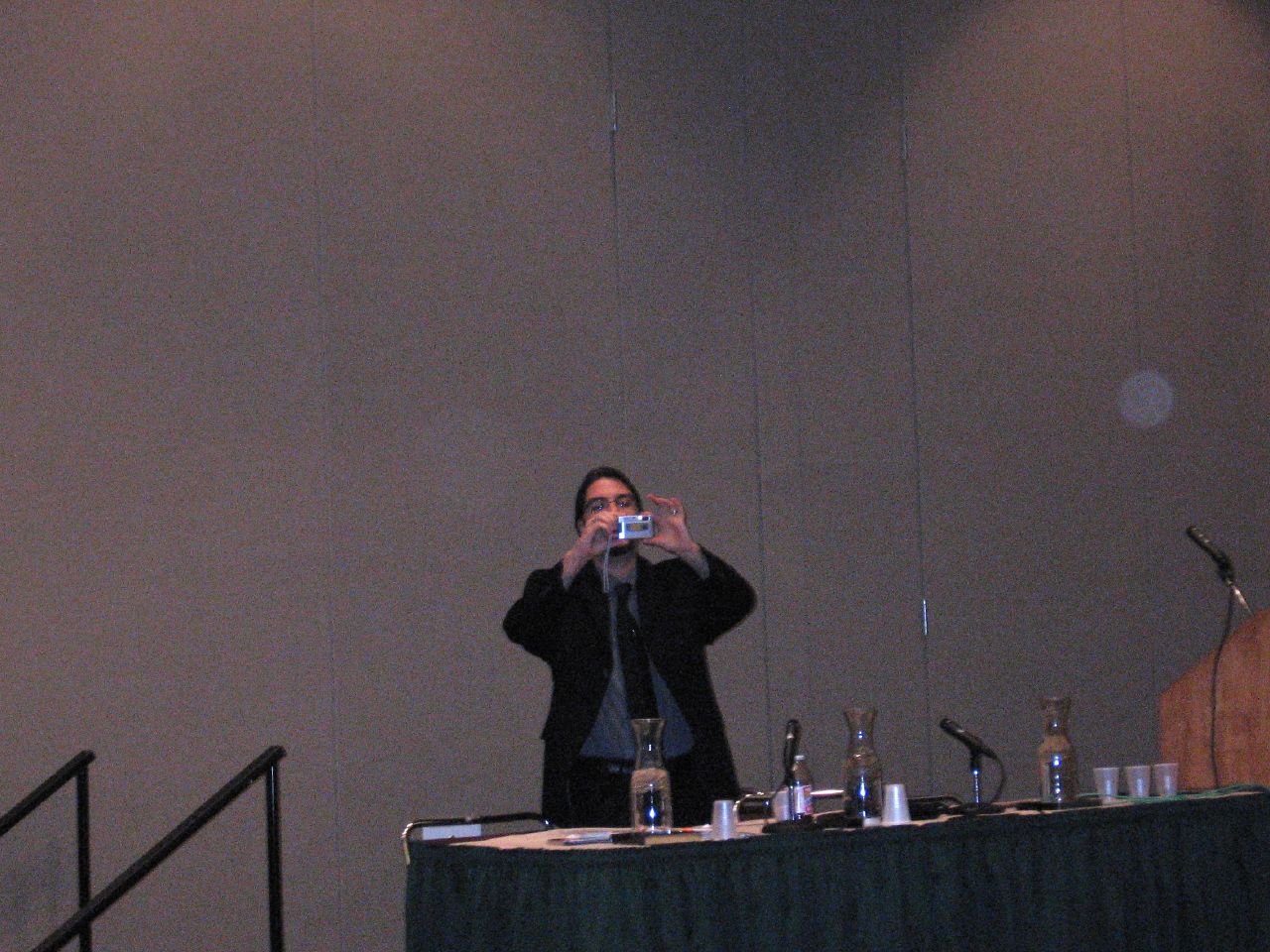
Michael Stephens started by taking a photo of the group. Here he is, I guess that in his, you will see me taking this photo.

One library uses Page Flakes as its start up page for all its public computers. He had some great examples including that the Library of Congress is using Flickr. Libraries need to be transparent, and need to talk in a human voice.

He talked about a lot of libraries including that Salt Lake Public will require that its new library director blog, Darien Public library has its circulation staff blogging.

Say yes to play! Hennepin County has done some great things as well. All of his slides will be up on his web site. Gwinnett County Public Library Flickr page is sort of a mini-web page. We need to throw out the culture of perfect.

Bring your heart to your job. We need to put a human face on library staff (which staff may not feel comfortable about -- editorial comment!) We need a carefully planned response to a changing world. Do it because you are meeting the mission and vision of the Library. How do we evaluate these new tools. In Australia there was a conference call on evidence-based librarianship. Have we reached an evaluation bypass? Singapore has a glass cubicle for cell phone users. Think about the library you are building for the future.

Michael closed with three thoughts:
  • Learn to learn
  • Adapt to change
  • Scan the horizon
John Blyberg, formerly at Ann Arbor and now at Darien (CT) Library, was next. His talk was called "Keen on 2.0: The Amateurs are Coming." Andrew Keen writes that every few centuries there is another great seduction. The last was communism. The new one is digital utopians. He had some great paraphrases of Keen's comments. He had the actual quote and a snarky translation, like "You sexy commies!" "Karl Marx -- a playa" "You might be boring" "You barbarian horde!" (I hope it puts the slide show up on the web! He gave a link, but they are not here yet.)

We tend to arc into the web and then find our way with conscious choices about where to go next in following links. Andrfew Keen's book is The Cult of the Amateur. We are moderates, Andrew Keen is an extremist. We need to encourage play and encourage the heart. Questions followed.